
REVIEW · WALKING TOURS
Rotterdam & Gouda Private Daily Walking Tour
Two Dutch cities, one smooth day.
This is a private route that strings together Rotterdam’s modern, post war architecture with Gouda’s tight medieval streets, starting with Rotterdam Centraal and finishing back where you began in Rotterdam. It runs in English, includes a mobile ticket, and can be paired with pickup options across Rotterdam, Gouda, and even Amsterdam.
What I love most is the contrast. You get architecture you can read, from the surviving 1525 Grote of Sint-Laurenskerk to the war era scars you see on landmarks like the Witte Huis. I also like the mix of quick photo stops with hands on time, including an interior visit at Kijk Kubus and the included visit to the Red Lion windmill, plus coffee or tea during the day.
The only real drawback is how packed it is. You’ll spend many stops around 5 to 20 minutes each, so if you want long indoor museum time, you will likely need to add on extra tickets for places like Saint John Church and the Gouda Cheese Experience.
In This Review
- Key highlights to look for on this tour
- Rotterdam to Gouda in one day: what this route actually feels like
- Rotterdam Centraal and the wartime survivors you notice first
- Erasmus, Markthal, and the modern food hall that feels like theater
- Oude Haven and Witte Huis: old port bones under newer skin
- Bridges, De Hef, and Leuvehaven: Rotterdam explained by movement
- Erasmus Bridge: the skyline photo you will understand after the water stops
- The Gouda transition: medieval town energy after the river engineering
- Saint John Church, Museum Gouda, and the stories hiding in plain facades
- Gateways, orphanage, and the Leper past you can actually point to
- Red Lion windmill: the included inside stop that makes the day feel worth it
- Price and value: what $592.56 per group really means
- Who this tour suits best, and who should rethink it
- Should you book this Rotterdam and Gouda private walking tour?
- FAQ
- How long is the Rotterdam and Gouda private daily walking tour?
- What is the group size limit?
- Where does the tour start and end?
- Is pickup available?
- What’s included in the price?
- What admission fees are not included?
Key highlights to look for on this tour
- Small group of 4 keeps questions and pacing easy, especially on a day with lots of short stops.
- Rotterdam’s water and bridges storyline is built into the route, not treated as random sightseeing.
- Markthal and Kijk Kubus show the city’s modern side in two very different ways.
- Gouda’s historic core walk hits city hall, churches with stained glass, and old gateways.
- Coffee or tea plus Red Lion windmill entry give you two true value wins without extra planning.
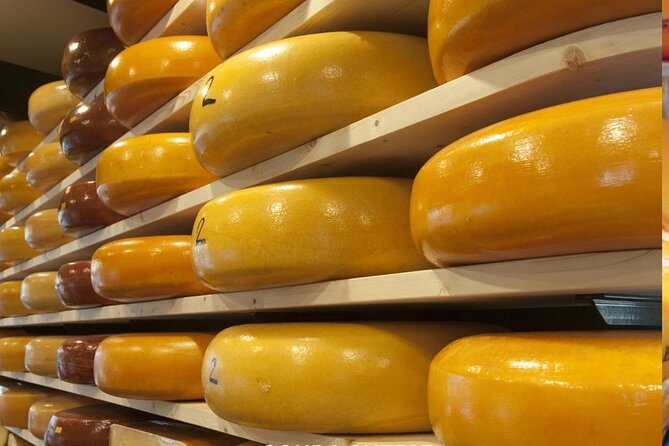
- Cheese time is optional but major, so know what you are paying for if you add the Gouda Cheese Experience ticket.
Rotterdam to Gouda in one day: what this route actually feels like
This tour is designed for people who want to cover big contrasts without eating up the whole day on logistics. Rotterdam gives you the big stage: rebuilt architecture, wide canals, and dramatic bridges. Then you slide into Gouda, where the streets feel narrower and the landmarks are older, with a stronger sense of a town that keeps its own pace.
The private format matters. With a maximum group size of 4, your guide can slow down for the details that catch your eye, like how certain buildings survived the 1940 bombings or why Rotterdam’s water system shaped daily life. You’re not stuck staring at a guide while the group drifts off.
Timing is the tradeoff. The day runs about 7 hours starting at 9:00 am, and most stops are brief. That’s great for momentum, but it means you should wear comfortable walking shoes and treat the day like a guided highlights walk, not a slow museum crawl.
More Walking Tours in Rotterdam
- Rotterdam: Architectural Highlights Guided Walking Tour
★ 4.8 · 215 reviews - Rotterdam: Highlights, Gems, Architecture & History Walk
★ 5.0 · 191 reviews - Rotterdam Walk: Hilights, Gems, Architecture & WWII | 2 or 3hrs
★ 5.0 · 149 reviews
Rotterdam Centraal and the wartime survivors you notice first
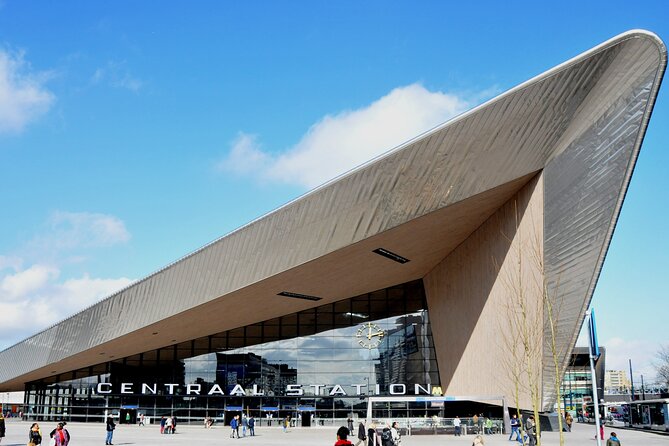
The day kicks off at Rotterdam Centraal Station, the main railway hub that handles around 170,000 passengers daily. From the outside, it’s the kind of modern monument that makes you instantly understand Rotterdam is not a town stuck in the past. If you like urban design, it’s a solid starting point because it sets the tone for a day focused on built form, not just scenery.
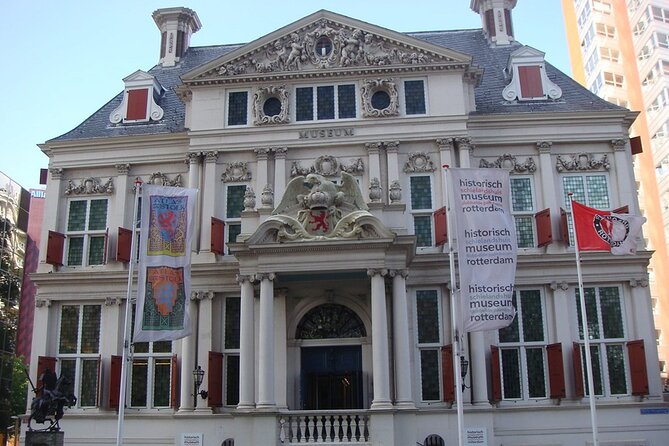
Right after that, you move into a story about water governance at the Hoogheemraadschap Schieland and Krimpenerwaard building. It’s a 17th century structure that once served as the headquarters of Waterschap Schieland, tied to water policy and management in this part of South Holland. The detail that sticks is that it was even temporary accommodation for Napoleon Bonaparte. This stop helps you see Rotterdam’s roots as a water managed landscape, not just a port city with cool views.
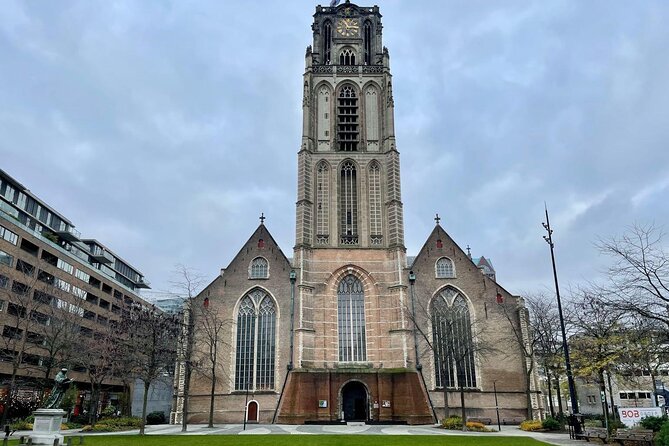
Then comes one of the emotional anchors of Rotterdam’s skyline: Grote of Sint Laurenskerk, a late Gothic church dating to 1525. It’s also noted as the oldest building in Rotterdam, and it’s remembered for surviving Nazi bombing on May 15, 1940. That survival detail changes how you see the city. The buildings around it look newer, but this one tells you a different timeline.
If you only remember one thing from this early cluster, make it this: Rotterdam’s big modern shapes are meaningful, but the few older survivors are what explain why so much was rebuilt.
Erasmus, Markthal, and the modern food hall that feels like theater
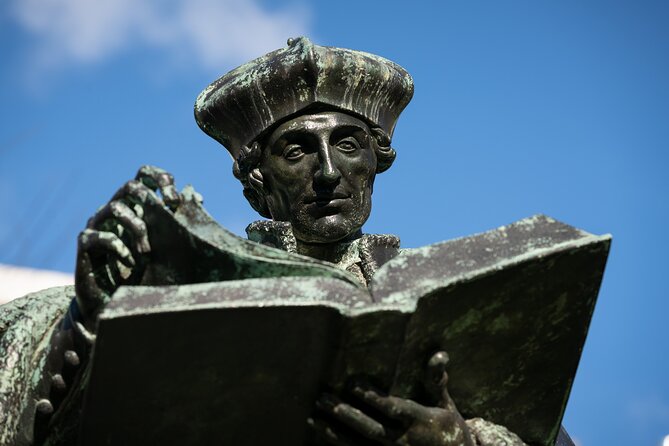
Once you hit the Erasmus Monument, the day shifts to intellectual Rotterdam. This landmark honors Desiderius Erasmus Roterdamus, known as Erasmus of Rotterdam. It’s one of those stops that takes a minute, but it matters because Erasmus is tied to how the city labels itself through education and public institutions.
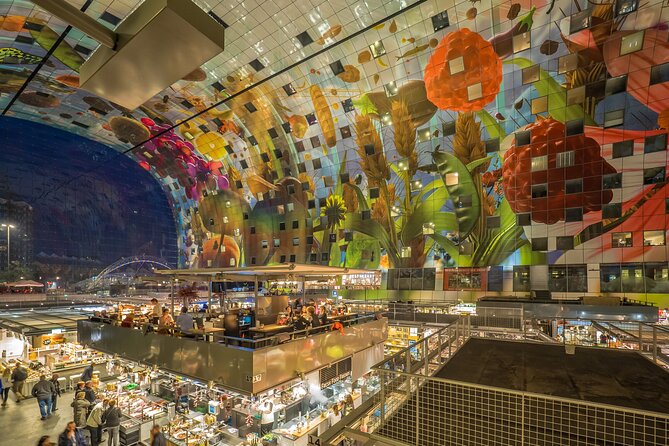
From there, the route lands at Markthal, the horseshoe shaped food market and living complex. It’s often described as the Sistine Chapel of Rotterdam, and even without going inside for a long time, the design concept is the point. This is a Rotterdam idea made physical: a space where you can live above a food hall, shop like it’s a market, and still feel like you are in a designed public interior.
The next stop, Kijk Kubus, is the kind of building you either love instantly or can’t stop thinking about afterward. These are the cube shaped apartments stacked on supporting columns, shaped like a tree of sorts. There’s an important practical detail here: because of the design, only 3/4 of the inner space is considered usable for typical living. That sounds odd until you see it as architecture that prioritizes form and visibility, not maximum efficiency. The tour includes admission here, so you get more than an outside glance.
If you like your modern architecture with a little weirdness, this is the highlight stretch.
Oude Haven and Witte Huis: old port bones under newer skin
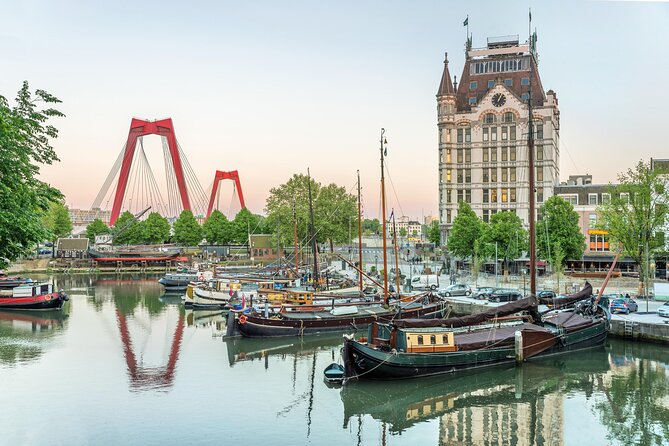
Oude Haven is one of Rotterdam’s older port areas, described as medieval Rotterdam’s older but not the oldest port, tied to the former river mouth of the Rotte flowing to the New Meuse. Today it’s a meeting place, with coffee bars, restaurants, taverns, and even disco clubs. This stop is your shift from landmark watching to street level atmosphere. You get to feel how a working port identity becomes social space.
Then you move to Witte Huis, once described as the highest skyscraper in Europe at the end of the 19th century. The big added value is that it is also listed as one of the rare buildings that survived the Nazi bombing on May 14, 1940. That pairs neatly with Grote of Sint Laurenskerk earlier. Together they help you map the city’s past resilience without making you read a book.
A different way to spend an afternoon around Rotterdam:
- Rotterdam: Harbor Sightseeing Cruise
★ 4.3 · 7,599 reviews - Rotterdam: 1-Hour Sightseeing Splash Tour
★ 4.5 · 3,299 reviews - Rotterdam: Rotterdam Zoo Blijdorp Entry Ticket
★ 4.6 · 2,754 reviews - Rotterdam: “Remastered” Digital Art Audiovisual Experience
★ 4.3 · 2,240 reviews
Bridges, De Hef, and Leuvehaven: Rotterdam explained by movement
Rotterdam’s bridges are not decorative. They are how people cross the city and how the city manages its relationship with water. The route leans into that with a string of river and bridge landmarks.
Willemsbrug, also called the Red Bridge, is dedicated to Willem III and connects central and northern Rotterdam with the southern districts. It’s a quick stop, but it’s a useful marker because you feel the city split into zones and then connected again.
Next is De Hef, meaning The Lift. This huge steel structure once served as a rotating or lifting train bridge across the New Meuse. It was in service before the rail tunnel went under the river. If you want the core logic of Rotterdam, spend your attention here. The city’s engineering choices tell you why rail, ship traffic, and river access had to be solved again and again.
Right along the river is the Monument to the Merchant Navy, de Boeg. It commemorates 3,500 people on board Dutch merchant ships who lost their lives in World War II. This is one of those stops that is brief but hits hard, especially after the previous design and bridge talk. It turns infrastructure into a human story.
Leuvehaven is next, and it gives you a different kind of perspective. It’s an open air maritime museum, focused on steamships, cargo machines and equipment, ship engines, and shipping related objects connected to the mid 19th century through the 1970s. Even if you don’t linger inside, it’s a clean way to understand Rotterdam as an industrial port with deep mechanical roots.
Erasmus Bridge: the skyline photo you will understand after the water stops
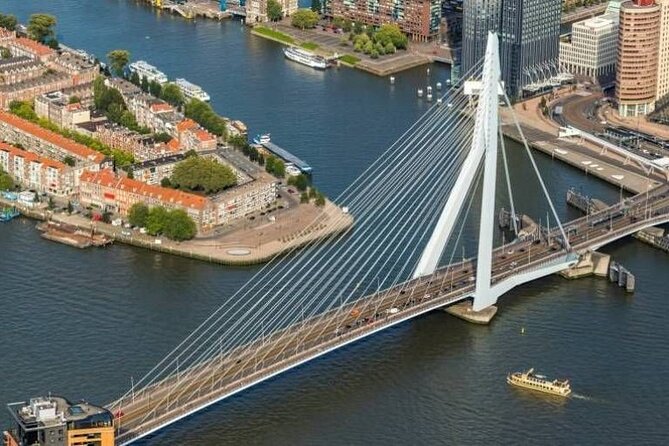
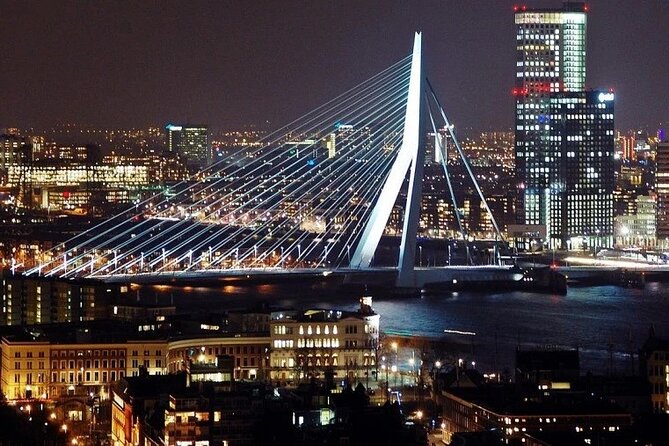
Erasmus Bridge is the youngest bridge in Rotterdam crossing the New Meuse, and it’s described as the most popular and known symbol. You may hear it called the Swan or the Harp, and the listed details include a height of 139 meters and an opening span that’s 80 meters.
By this point in the day, you have already seen why bridges matter here. You have watched the route move from architecture to river life to maritime memory. So even if you’ve seen images of Erasmus Bridge before, you’ll get a fuller sense of why it became Rotterdam’s face.
The Gouda transition: medieval town energy after the river engineering
After Rotterdam’s modern icons, Gouda feels like a gear shift. The walk becomes more about old stone, church details, and narrow street landmarks. You still get guided context, but the pace and mood change.
The day includes the Gouda Cheese Experience as a dedicated stop, with a noted ticket time around 45 minutes. The experience is described as 3 in 1: entertainment, degustation, and education. The admission fee for this part is listed as not included, so think of it as an add on you decide up front. If you know you want to taste and learn, you’ll probably want to plan for that cost early.
You then see Stadhuis Gouda, the city hall building described as the oldest existing city hall building in the Netherlands, dating to 1459. It’s one of those landmarks that makes a town feel like it has a memory you can touch.
A short distance away is VVV Gouda, noted as a custom house mostly connected with cheese trade from 1668. The name is practical, but the history under it is the payoff. It turns Gouda’s cheese identity into something that shaped trade infrastructure, not just a product label.
Saint John Church, Museum Gouda, and the stories hiding in plain facades
Gouda keeps rewarding attention to visual details. Saint John Church is famous as the longest church in the Netherlands and it’s known for 72 stained glass windows. Admission is listed as not included, so you might just see the exterior unless you decide to pay for the inside visit. Even from the outside, it’s one of the stops that signals you are in a town where religious art is treated like a big deal.
Museum Gouda, in St Catherine Gasthuis, is also listed as ticketed and not included. This stop has a lot of layered purpose over time. It’s described as a former mental hospital, prison and torture chamber, plus an art building and even a horse stable. That’s a heavy mix, but it also explains why museum buildings in Europe can feel like they carry every era at once. If you prefer lighter stops, you can treat this as a quick exterior moment and spend your energy elsewhere.
Tapijthuis adds another shift, both literal and thematic. It’s a medieval building tied to tapestry weavers, described as a former workshop by Flemish tapestry weavers. It also has references to a secret Catholic children school, a 19th century brewery, and later an art studio and gallery. You get to see how one building can support many identities over centuries without changing address.
Gateways, orphanage, and the Leper past you can actually point to
Some of Gouda’s most memorable stops are small gateways and building names that sound strange until you connect them to what they once served.
Arti Legi is listed as one of Gouda’s buildings with a rich range of functions across the city’s history. It’s another quick stop, but it helps you read the town as a place where institutions reused space over time.
There’s also the tuin van het Willem Vroesenhuis, described as an elderly house with a picturesque backyard. Lazaruspoortje is a famous landmark gateway to a former house that hosted people suffering from leprosy. It’s brief, but it gives you a tangible place name tied to a real social history.
Rijksmonument De Visbanken marks a former fish market established in the mid 16th century. Asschuur is another name that sounds utilitarian, and that’s the point. It’s described as a middle 19th century ash warehouse, used when potash was used for soap and glass production.
Evangelisch Lutherse Gemeente Gouda is a church dedicated to St Joost, noted as the patron of bag carriers and their guild. Remonstrantse kerk is listed as a chapel connected to the Remonstrant Brotherhood Community, a Protestant movement that split from the Dutch Reformed Church in the early 17th century.
Finally, Weeshuis is described as a former orphanage from 1643, now used as a high rated and exclusive hotel. That last fact is useful because it shows how the town keeps reusing older structures rather than replacing everything.
If you enjoy history that shows up in street level labels, you’ll like this part of the walk.
Red Lion windmill: the included inside stop that makes the day feel worth it
Mid to late in the Gouda portion, you hit the Red Lion windmill, also called Molen De Roode Leeuw. This stop comes with included admission, and it’s described as one of the oldest still existing flourmills in the Netherlands that retains its original shape inside and out.
This is a strong inclusion because it’s not just another look from the street. Windmills are usually a “sure, we saw it” stop. Here you have a reason to budget time and attention for it, and because admission is included, you avoid the add on feeling for at least one major attraction.
Price and value: what $592.56 per group really means
The total price is $592.56 per group, for up to 4 people. For a full group of 4, that’s about $148 per person for about 7 hours of guided walking across two towns. If you only have 2 people, it effectively doubles per person.
So where is the value? The big value is that you are paying for a private guide to connect a lot of landmarks with context, not just to shepherd you between dots on a map. You also get coffee and or tea, plus the included windmill admission. For the optional ticket stops, you only pay when you decide you want them.
Budget extras because they are listed. Saint John Church has an admission fee of €11 per person. The Gouda Cheese Experience is €16 per person. The information also lists public transportation as €15 per person. Since the tour says transportation is included within the 7 hour duration, I treat that €15 as something you might need if you end up using public transit during the day, rather than something you can ignore.
One more practical value point: this tour is described as customizable, with pickup possible from hotels in Rotterdam or Gouda, and even from Amsterdam Central Train Station or Amsterdam Passenger Terminal, Dam Square. That can save you time and stress if your hotel location is awkward for public transport.
Who this tour suits best, and who should rethink it
This works best for you if you:
- Want a private guide and a small group size.
- Like architecture and city design, especially Rotterdam’s post 1940 rebuilding and its river related infrastructure.
- Enjoy history that shows up in names, gates, churches, and trade buildings around Gouda.
It might not suit you as well if you:
- Want long museum time and lots of unstructured browsing, because the schedule leans to many short stops.
- Prefer to avoid ticketed interiors, because several major sites have admission fees listed for you to choose.
Should you book this Rotterdam and Gouda private walking tour?
Yes, if you want a smart day that connects two cities through design, water, and historic town fabric. The included windmill entry and the coffee or tea help the day feel practical, not just scenic. And the small group size keeps the pacing human.
I’d say book it with the mindset that the tour is a highlights walk with optional ticket time, not a deep museum study. If you plan ahead for the Gouda Cheese Experience ticket and decide whether Saint John Church is worth the extra €11, you’ll feel in control instead of rushed.
If you are traveling with a group of 3 or 4 and you care about seeing both cities without juggling trains, this is a strong value way to spend a day in South Holland.
FAQ
How long is the Rotterdam and Gouda private daily walking tour?
It runs for about 7 hours.
What is the group size limit?
The tour has a maximum of 4 travelers.
Where does the tour start and end?
It starts at the Port of Rotterdam, Wilhelminakade 909, 3072 AP Rotterdam, Netherlands, and it ends back at the meeting point.
Is pickup available?
Yes. Pickup can be arranged and it may be customized, including pickups at hotels in Rotterdam or Gouda, or from Amsterdam Central Train Station or Amsterdam Passenger Terminal, Dam Square.
What’s included in the price?
Coffee and/or tea are included, and entrance to the windmill The Red Lion (Molen De Roode Leeuw) is included. The tour also provides a mobile ticket.
What admission fees are not included?
Saint John Church is listed at €11 per person, and the Gouda Cheese Experience is listed at €16 per person. Public transportation is also listed at €15 per person.
Newest bookings around Rotterdam
- e-Scavenger hunt Breda: Explore the city at your own pace★ 4.5 · 27 reviews
- e-Scavenger hunt Rotterdam: Explore the city at your own pace★ 4.5 · 13 reviews
- Rotterdam: City Walk Audio Guide in 7 Languages on your Phone★ 3.5 · 6 reviews
- All-Inclusive Private Windmill Tour to Kinderdijk from Rotterdam★ 4.5 · 59 reviews
- Rotterdam Must Do Tour: Highlights, History, WW2 and Architecture★ 5.0 · 20 reviews
- Rotterdam in half a day: All-inclusive, Authentic private Tour of Rotterdam★ 5.0 · 146 reviews
- Discover Rotterdam: Classic Highlights Bike Tour with a Local★ 5.0 · 22 reviews
- Breda Fun Puzzle Quest: True Lord Self-Guided Tour★ 4.0 · 9 reviews
Walking Tours, compared.
Amsterdam Anne Frank: Small-Group Walking Tour & Local Guide
Read our review →
Anne Frank’s Story – Guided Walking Tour through Amsterdam
Read our review →
Absolutely Amsterdam – the Essential Introductory Walking Tour
Read our review →
Anne Frank Guided Walking Tour in DE/EN/IT/ES
Read our review →
Anne Frank Walking Tour Amsterdam Including Jewish Cultural Quarter
Read our review →Browse the lists this tour appears in