
REVIEW · DELFT TOURS
Rotterdam & Delft Private Offshore Daily Walking Tour
Two cities, one tight walking day.
This private Rotterdam and Delft tour strings together major sights in about 7.5 hours, with stops that range from bold modern architecture to carefully preserved war survivors. I especially like the small group size (max 4), which makes it easier to pause for photos, ask questions, and keep a comfortable pace. I also love that the tour includes Cube Houses admission plus coffee and/or tea as part of the experience. The one drawback to plan for is cost and extras, because several big-ticket interiors in Delft are not included and you may want public transport depending on how you arrive and move between areas.
The guide here seems to set the tone, and the name that came up most clearly is Alex. In real situations he has adjusted the day to match interests and even mobility limits, and he went above and beyond to help when a traveler’s luggage was lost, including escorting someone by train to the airport.
If you want a guided day that feels efficient but still human, this is a great fit. If you prefer slow museum time with zero extra spending, you might want a different style of tour.
In This Review
- Key things I’d circle on your plan
- Why this Rotterdam to Delft walking route works
- Group size, timing, and the pace you should expect
- Starting at the Port of Rotterdam and Rotterdam Centraal
- Water management and the city shaped by resilience
- Erasmus Monument to Markthal: philosopher’s pause and food-hall power
- Cube Houses (included) and why their design is clever
- Oude Haven and Witte Huis: old port charm meets survival
- Bridges and engineering shows: Willemsbrug, De Hef, De Boeg
- Leuvehaven to Erasmus Bridge: maritime museum energy to the city’s symbol
- How the Delft switch feels: Station Delft and Delft’s civic layer
- Begijnhofpoort, the leaning Old Church, and why Delft feels intimate
- Vermeer, royal power, and the big church interiors you may pay for
- Royal Delft and the blue porcelain obsession
- What you actually get included, plus the extra costs to plan for
- Is the price worth it?
- Quick reality check on comfort and expectations
- Should you book this Rotterdam & Delft private walking tour?
Key things I’d circle on your plan

- Max 4 people keeps the day flexible and conversation-friendly
- Pickup in Rotterdam or Delft means less stress before you start walking
- Cube Houses are included, so you skip at least one common ticket hassle
- Lots of war-survivor architecture, including churches and iconic buildings with real stories
- Coffee or tea is included, which helps on a long 7.5-hour day
- Many Delft interiors cost extra, so budget ahead if you want to go inside
Why this Rotterdam to Delft walking route works
Rotterdam and Delft are very different cities, but they fit together like a good pair of shoes. Rotterdam gives you the “how this city functions” feeling, from water management to bridges that make rail and river life possible. Delft gives you the “how people lived and believed” feeling, with canals, courtyards, churches, and the blue ceramics that shaped Dutch identity.
What makes this tour practical is the way it balances exterior sights with a few interior moments you can opt into. Most stops are short, roughly 10 to 20 minutes each. That sounds fast, but it works when your goal is to see many landmarks, learn what matters, and decide on your own after the tour what you want to revisit.
And because this is private for up to four people, you are not stuck with a slow shuffle behind a crowd. You can ask, move on, and keep the day feeling like a guided walk rather than a checklist.
More Walking Tours in Delft
- Delft: City Center Walking Tour
★ 4.7 · 88 reviews - Walking Tour of Delft – The City of Orange and Blue
★ 5.0 · 50 reviews - Private Walking Tour of Delft: Dive into the Dutch Golden Age
★ 5.0 · 33 reviews
Group size, timing, and the pace you should expect
This is a 7 hours 30 minutes experience with travel time included. You’re not just “walking” the whole day. The schedule is built around short viewing stops, then moving to the next cluster.
That pace is a plus if you like structure. You will hit major sights without needing to plan transport or ticket order yourself. It can be tiring if you are sensitive to lots of stops and standing around for 10 minutes here and there, especially in breezy waterfront areas.
Also note the tour runs 9:00 AM to 6:00 PM, Monday through Sunday, within the listed season window (03/22/2024 to 02/25/2027). So you have daylight time most of the year, which matters for bridges and canal views.
Starting at the Port of Rotterdam and Rotterdam Centraal
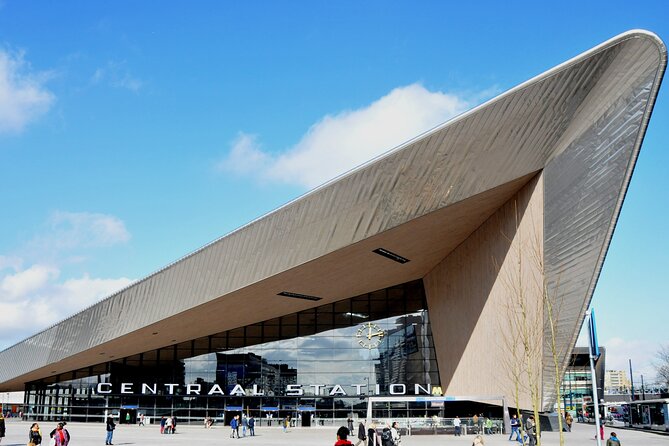
The tour begins at the Port of Rotterdam, Wilhelminakade 909, 3072 AP Rotterdam. From there, it starts with Rotterdam Centraal Station, a major architectural showpiece. This is the city’s main railway hub, serving huge numbers of passengers daily. Even if you don’t care about train stats, the building gives you a useful anchor point for the rest of Rotterdam, because it signals the city’s modern mindset.
I like making this first stop because it sets the tone. You get the “big city energy” early, then you can switch gears to the quieter, older layers later.
Water management and the city shaped by resilience
Right after Centraal, you head toward the Hoogheemraadschap Schieland and Krimpenerwaard, a 17th-century building tied to water policy and management in South Holland. Water control is not a side topic here, it’s central. Rotterdam exists the way it does because people had to manage water, land, and risk for centuries.
There’s also a historic connection here: the building was temporary accommodation for Napoleon Bonaparte at one point. Even if you only catch the gist from the outside, it’s a reminder that this region has always been strategic.
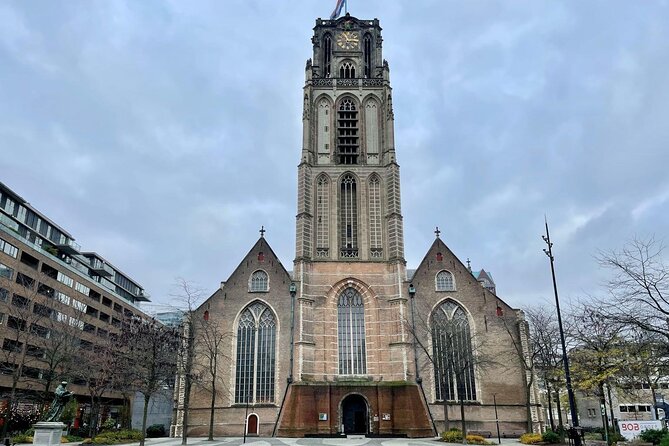
Then the route moves to Grote of Sint-Laurenskerk, a late Gothic church dated to 1525. This is one of the oldest buildings in Rotterdam, and it survived Nazi bombing on May 15, 1940. That war-survival thread repeats later in the tour, and it is worth paying attention to. You’ll start seeing how modern Rotterdam preserved certain anchors while rebuilding the rest with a different spirit.
More Walking Tours in Rotterdam
- Rotterdam: Architectural Highlights Guided Walking Tour
★ 4.8 · 215 reviews - Rotterdam: Highlights, Gems, Architecture & History Walk
★ 5.0 · 191 reviews - Rotterdam Walk: Hilights, Gems, Architecture & WWII | 2 or 3hrs
★ 5.0 · 149 reviews - Rotterdam 2-Hour Walking Tour | Discover The City With A Local
★ 4.5 · 111 reviews
Erasmus Monument to Markthal: philosopher’s pause and food-hall power
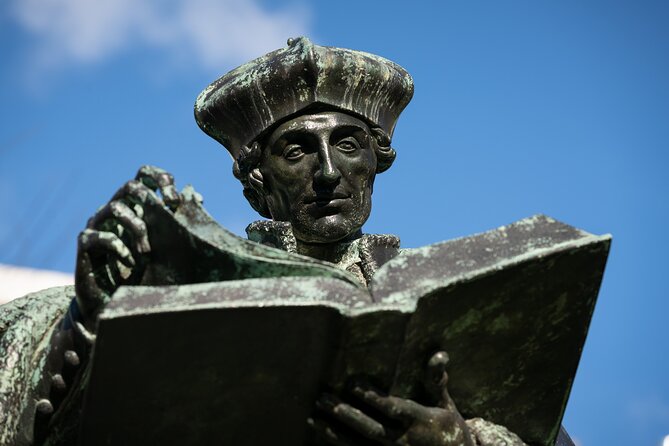
A quick cultural reset comes with the Erasmus Monument, honoring Desiderius Erasmus of Rotterdam, a major 16th-century thinker who shaped theology and scholarship. Rotterdam loves naming places for big thinkers, and this is a good example of the city treating ideas as part of its public landscape.
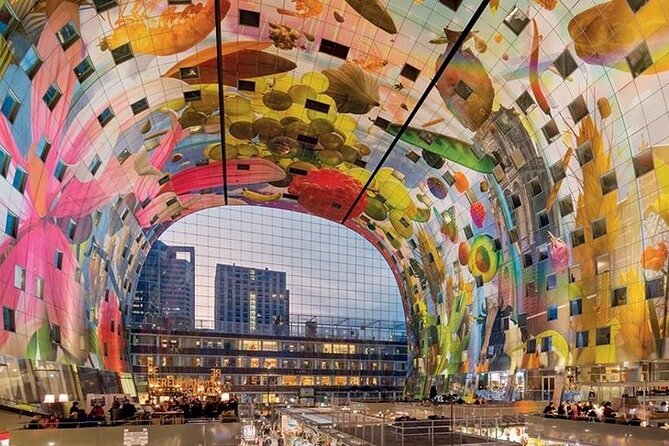
Next up is Markthal, a horseshoe-shaped market hall that also includes living and facilities. It’s famously nicknamed the Sistine Chapel of Rotterdam, because the interior artwork can feel like a ceiling you want to stare at. This stop is free and short, but it gives you a chance to orient yourself for food and street life. Even if you don’t buy anything, you’ll understand why locals treat this area as a social center.
Cube Houses (included) and why their design is clever
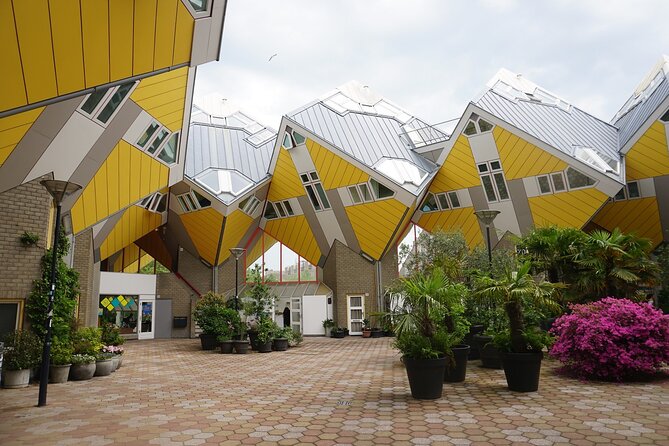
One of the best included moments is Kijk-Kubus, the cube-shaped apartment design on supporting columns. The key practical detail is that the unusual shape means only about three quarters of the interior space is usable for typical living. That’s exactly why the building is interesting. It’s not just a gimmick, it is an argument about form, engineering, and how people accept tradeoffs in exchange for originality.
This is also your included entrance, so you are not deciding whether it’s worth the ticket. It just becomes part of your day, and it tends to be the stop where you hear the most “wow, that is different” energy.
Oude Haven and Witte Huis: old port charm meets survival
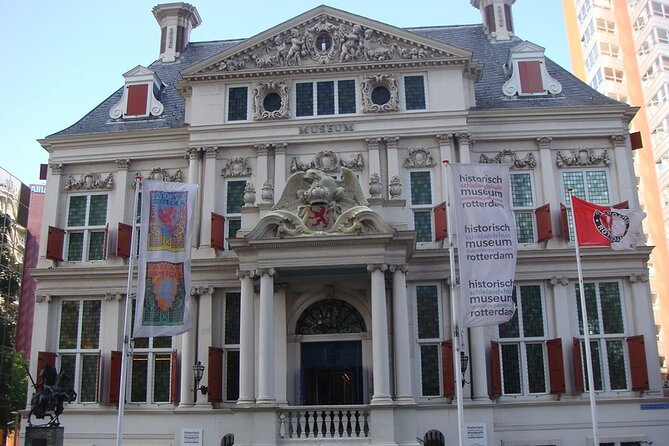
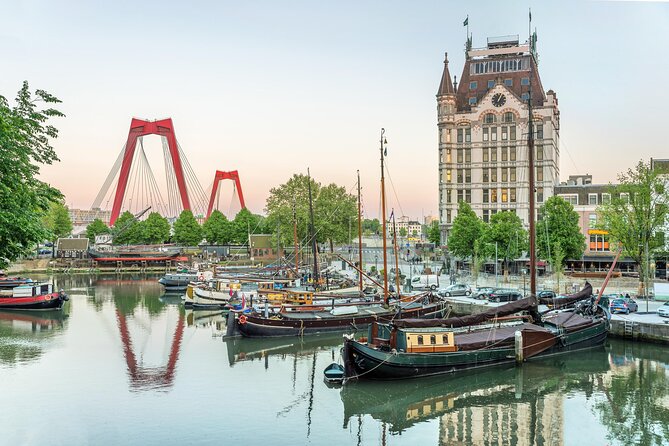
Now you shift to Oude Haven, one of Rotterdam’s oldest ports, though not the very oldest. It’s a medieval port area that used to mark the river Rotte’s path to the New Meuse. Today it’s a gathering place with coffee bars, restaurants, taverns, and even late-night options. The practical value here is that you get a real feel for how Rotterdam socializes, not just how it builds.
A nearby architectural marker is the Witte Huis, once one of Europe’s highest skyscraper-like buildings and another survivor of the May 14, 1940 bombing period. Rotterdam’s modern identity can feel sleek, but this reminds you the city’s skyline includes hard-won continuity.
Bridges and engineering shows: Willemsbrug, De Hef, De Boeg
Rotterdam is a bridge city, and your route makes that clear.
- Willemsbrug, called the Red Bridge, connects northern and southern parts of central Rotterdam and is dedicated to Willem III.
- De Hef is the huge steel “Lift” structure that historically acted like a train bridge across the New Meuse. It functioned before the rail tunnel went under the river, so it’s part of Rotterdam’s earlier engineering era.
- De Boeg is a war memorial on the New Meuse embankment, commemorating 3,500 men and merchant ship crew who died during World War II.
These stops are short, but they create a story. You see how river access and rail access shaped daily life, then you see what war took away. That combo is why the walking stays meaningful rather than purely scenic.
Leuvehaven to Erasmus Bridge: maritime museum energy to the city’s symbol
Leuvehaven is an open-air maritime area with a collection of steamships, cargo machines, ship engines, and other shipping-related objects from about the mid-19th century to the 1970s. Even as a brief stop, it gives you context. Rotterdam didn’t become important by accident. It became important through shipping and industry, then had to modernize without erasing the past completely.
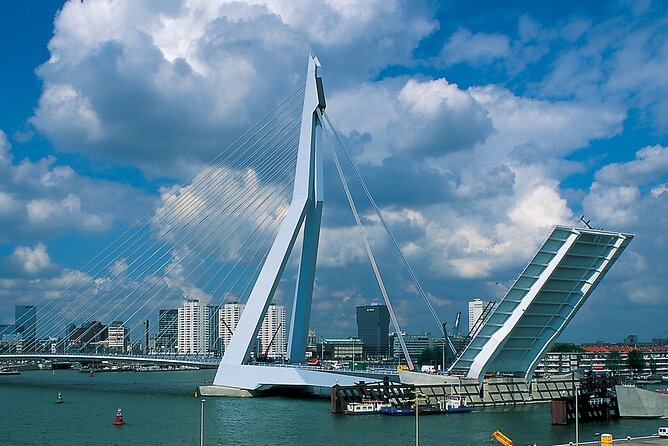
Then comes Erasmus Bridge, the hanging bridge that is basically Rotterdam’s poster image. It’s also known as the Swan or the Harp. It crosses the New Meuse, and the height and scale are exactly the kind of numbers that help you appreciate it: around 139 meters high, with an opening part about 80 meters long. This is a stop where you’ll benefit from slowing down, even if the visit is planned short. Look for the lines of the bridge against the river, and you’ll understand why this city markets itself around bold structure.
How the Delft switch feels: Station Delft and Delft’s civic layer
After Rotterdam, the tour transitions to Delft with a stop at Station Delft. This is described as a modern underground energy sustainable station with the city hall above it, plus a nod to Delft blue ceramics.
That matters because Delft is not just old buildings. It’s civic design, city planning, and the way art and governance share space. It’s a smart shift from Rotterdam’s industrial form to Delft’s careful identity.
From there, your Delft route focuses on historical institutions and quiet corners, many with short stops:
- Sociëteit het Meisjeshuis, a girls orphanage from 1578 that served until the 1950s.
- The Netherlands Cancer Institute (NKI) monument tied to a Delft citizen and microscope-related legacy.
- Gemeenlandshuis van Delfland, a 16th-century building tied to local water management.
- Stadsarchief Delft, a former Latin language school and military barracks now serving as the city archive.
I like this sequence because Delft can otherwise blur into “pretty streets and churches.” These stops remind you it’s also a living administrative and scientific community.
Begijnhofpoort, the leaning Old Church, and why Delft feels intimate
Next you reach Bagijnhofpoort, a semi-closed memorial area for the beguines, a type of religious order similar to nuns. The word begijnhof often signals calm courtyards and semi-private life. Here it acts like a pause in the walking, which you’ll appreciate on a full-day itinerary.
Then comes Old Church, Delft’s “Dutch Pisa’s Tower” moment. It’s the oldest church in Delft from 1246, with a tower that leans about two meters from vertical. That leaning detail makes it one of those landmarks you can spot even without a guide pointing it out. You’ll likely want to stand at a distance first, then walk slightly to see the angle change.
After that, there’s Stadhuis Delft on the main market, a former city hall building from 1620. Even in a quick stop, the value is practical: this is the kind of central square where you can orient yourself if you later return on your own.
Vermeer, royal power, and the big church interiors you may pay for
There are several culture layers tied to Dutch identity in Delft, and this route includes them.
- Vermeer Centrum Delft is an information point about Johannes Vermeer, including style, painting meaning, and his personal life. The admission is not included, so you’ll need to decide if you want to add that expense during the day.
- Hugo de Groot Monument honors Hugo Grotius, philosopher, jurist, humanist, writer, diplomat, and a founder of international law.
The itinerary also includes major church exteriors and interiors with optional entries:
- Museum Prinsenhof Delft has a not included admission. This area is tied to the residence and death of Willem the Orange.
- New Church is where Willem the Orange and members of the Dutch royal family are associated as funeral sites, but the specific admission price is not listed in your details.
- Maria van Jessekerk is a 19th-century Catholic church.
I’ll be honest about the tradeoff: these are the places where you could spend extra time, and yet the tour keeps them moving. If churches and art are your top priority, you might want to treat this day like a guided sampler, then pick one interior to return to later.
Royal Delft and the blue porcelain obsession
The tour ends with a stop for Royal Delft (Koninklijke Porceleyne Fles), a world-famous majolica pottery. You’ll get the history, workshop context, and exhibition plus selling, based on what the stop is described to include.
Admission is not included here. That doesn’t make it a bad stop, it just means you choose how deep you go. If you love ceramics, Dutch design, and the story of blue shades, this is usually worth adding. If you are less into pottery and more into architecture, you can use the time to focus on photos and the outside vibe.
What you actually get included, plus the extra costs to plan for
Here’s the part you should budget for before you book.
Included:
- Coffee and/or tea as part of the tour experience
- Cube Houses (Kijk-Kubus) entrance
Not included (with set prices provided for some):
- Nieuwe Kerk: €15.00 per person
- Museum Prinsenhof Delft: €14.00 per person
- Old Church: €8.00 per person
- Vermeer Centrum Delft: €12.00 per person
- Public transportation: €10.00 per person
Other sights are marked as admission not included without a listed price in your details, like New Church and Royal Delft, so you’ll want to check at booking or on arrival for exact pricing.
Is the price worth it?
The listed price is $5,683.71 per group for up to 4 people. That sounds high until you translate it into a private guiding day with pickup and a structured route across two cities.
Value comes from a few places:
- You avoid coordinating public transport between Rotterdam and Delft yourself during a long walking day.
- You get a guide who can adjust the pace and route, and the name that surfaced clearly is Alex.
- You get at least one meaningful ticket included, Kijk-Kubus, plus coffee and/or tea.
- You cover a lot of landmarks in one go, so you are paying for time efficiency and interpretation.
If you are two people, the cost per person can feel steep, but private tours often are. If you are four people, the math becomes more reasonable, especially if you all want guided context and not just a self-walk route.
Quick reality check on comfort and expectations
This is a walking-focused itinerary with many short stops. You will be on your feet a lot, even if each stop is brief. Rotterdam’s waterfront areas can be windy, and Delft’s streets can involve a fair number of turns and steady walking segments.
What helps is that the tour is private and the guide can adjust the plan based on interests and mobility limitations. Still, you should come ready for a full day outdoors, not a sit-down museum loop.
Also, the schedule is built for seeing a lot. If you need long interior time, you may need to prioritize which paid interiors you want and which you can skip.
Should you book this Rotterdam & Delft private walking tour?
I’d book it if you want:
- A private day for up to four people
- A guided route that hits Rotterdam’s bridges, ports, and war-survivor architecture plus Delft’s churches and blue ceramics
- A plan that includes Cube Houses and a small comfort break with coffee or tea
- A guide who has shown he will adjust to what matters to you, including mobility considerations, as shown by the examples tied to Alex
I would hesitate if you:
- Hate paying extra for interiors, because multiple Delft highlights list admission fees you may want to add
- Want a slower pace with deep museum time rather than many short stops
- Are not planning for a long walking day
My practical advice: if interiors are your priority, decide your top two or three paid stops in advance, then keep the rest as “see from outside” moments. That way you control spend and still get the best of both cities in one day.
Newest bookings around Rotterdam
- e-Scavenger hunt Breda: Explore the city at your own pace★ 4.5 · 27 reviews
- e-Scavenger hunt Rotterdam: Explore the city at your own pace★ 4.5 · 13 reviews
- Rotterdam: City Walk Audio Guide in 7 Languages on your Phone★ 3.5 · 6 reviews
- All-Inclusive Private Windmill Tour to Kinderdijk from Rotterdam★ 4.5 · 59 reviews
- Rotterdam Must Do Tour: Highlights, History, WW2 and Architecture★ 5.0 · 20 reviews
- Rotterdam in half a day: All-inclusive, Authentic private Tour of Rotterdam★ 5.0 · 146 reviews
- Discover Rotterdam: Classic Highlights Bike Tour with a Local★ 5.0 · 22 reviews
- Breda Fun Puzzle Quest: True Lord Self-Guided Tour★ 4.0 · 9 reviews
Delft Tours, compared.


Rotterdam, Delft and The Hague Day Trip from Amsterdam
Read our review →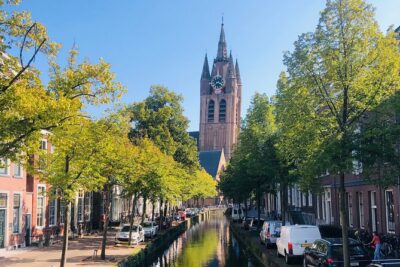
Rotterdam, Delft and The Hague Small Group Tour from Amsterdam
Read our review →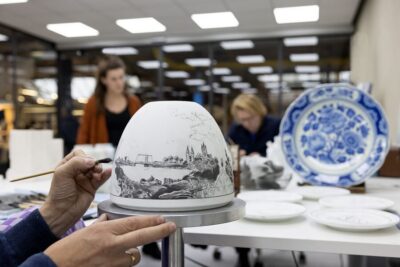

The Hague, Delft and Rotterdam Small-Group Tour (Max. 8 People)
Read our review →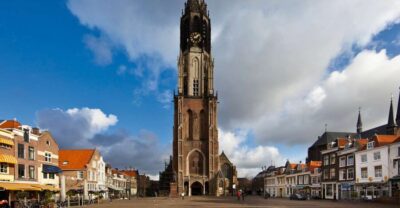
Rotterdam, Delft, The Hague Day Tour Incl. Madurodam/Royal Delft
Read our review →Browse the lists this tour appears in