
REVIEW · WALKING TOURS
Walking Tour about Golden Age Architecture, private local guide
Amsterdam tells its story through buildings. On this private Golden Age architecture walking tour in Amsterdam, you get a local guide who helps you see what most passersby miss, from merchant wealth to engineering on marshy ground. It is a tight 1.5-hour route that still hits major landmarks and the canal-belt details that explain how the city grew in the 1600s.
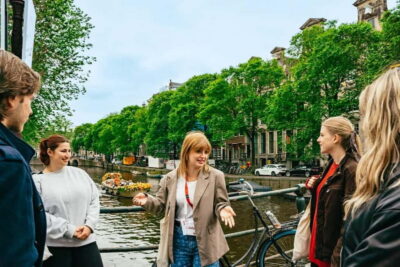
I love how the tour connects architecture to real life, not just fancy facades. Anna’s explanations link design choices to trade, status, and construction tricks, so the buildings feel understandable fast. I also like the pace of a private format, with time to ask questions and pause for photos without feeling rushed.
One consideration: it is mostly a standing and walking experience for about 1.5 hours, and it is not recommended if you use a walker or struggle with walking and standing for that long. Also, bottled water is not included, so plan to bring your own.
In This Review
- Key points that make this tour a smart pick
- Golden Age architecture, but with street-level meaning
- Price and value: what $73.59 gets you (and why it can be worth it)
- Dam Square to Royal Palace: starting with power and money
- Huis Bartolotti: red brick, sandstone carvings, and Italian trading ties
- Torensluis bridge views: mercantile facades and crooked-house reality
- De Dolphijn and Rembrandt’s famous captain connection
- Ronde Lutherse Kerk: domes, priorities, and a change in architectural mood
- Prinsengracht warehouses: gables, windows, and hoisting beams for cargo
- Jordaan and gevelstenen: reading facade stones like clues
- Westerkerk: spire height, Rembrandt’s grave, and Anne Frank’s clock
- How to get the best from your 1.5-hour walk
- Should you book this Golden Age architecture walking tour with Anna?
- FAQ
- How long is the walking tour?
- Is this tour private?
- What language is the tour offered in?
- Where do I meet the guide, and where does the tour end?
- How much does the tour cost?
- What is included in the price?
- Are admission tickets required for the stops?
- Is bottled water included?
- Is it suitable if I use a walker?
Key points that make this tour a smart pick
- Private, just your group: you are not packed in with strangers.
- Stop-by-stop Golden Age focus: you cover canal-belt landmarks and merchant architecture in one outing.
- Anna’s design and engineering stories: clay foundations, hoisting beams, and why buildings lean.
- Photo-friendly details: facades, carvings, symbols, and street-level “read-me” clues.
- Ends near the Anne Frank House area: you can keep exploring afterward on foot.
Golden Age architecture, but with street-level meaning
This is the kind of Amsterdam tour that helps you read the city. You start with the political and ceremonial center, then move into the canal belt, where wealth from global trade shaped the buildings you still see today. Instead of treating architecture like a museum display, the guide frames it like a practical tool.
You learn why the same era can look different from street to street. Baroque details show up in mercantile neighborhoods. Neoclassical style defines power buildings. And then you get the “how did they even build this” moments, like structures needing clever solutions for soft, marshy ground.
Another big plus for your comfort and planning: the route is compact. With an overall duration of about 1 hour 30 minutes, it fits well into a first or mid-trip day when you want orientation plus real details. It is also offered in English, so you can follow every stop without playing catch-up.
More Walking Tours in Amsterdam
- Amsterdam Anne Frank: Small-Group Walking Tour & Local Guide
★ 4.8 · 12,789 reviews - Anne Frank’s Story – Guided Walking Tour through Amsterdam
★ 5.0 · 11,619 reviews - Absolutely Amsterdam – the Essential Introductory Walking Tour
★ 5.0 · 3,629 reviews
Price and value: what $73.59 gets you (and why it can be worth it)
At $73.59 per person for a 1.5-hour private walking tour, you are paying for three things: expert interpretation, a route designed for maximum architectural payoff, and flexibility to ask questions. If you have ever wandered Amsterdam’s canals for hours and still felt like the buildings were just “pretty,” this kind of guided structure can save you time and frustration.
You also get free admission at the featured stops listed in the itinerary. That matters in Amsterdam, where paid entries can add up fast. Here, the value comes from learning to notice what the average street-level walk skips, like construction challenges and how symbols and facade stones signaled profession and status.
One practical note: bottled water is not included. Build that into your budget and bring something to sip, especially if you are doing this in warm weather.
Dam Square to Royal Palace: starting with power and money
The walk begins at Royal Palace Amsterdam, at Nieuwezijds Voorburgwal 147. It is a smart starting point because you immediately connect Amsterdam’s “who mattered” story to what you see in stone and brick.
Stop 1: Dam Square is where the guide sets the stage. You get the context for why Amsterdam rose in the 17th century, including its role as a global trade hub. That trade wealth is the fuel behind the architecture you will see later, from merchant houses to warehouse gables. Dam Square is busy, but it is also the right place to start because it anchors the city’s big-picture narrative before you get lost in details.
Then Stop 2: Royal Palace Amsterdam shifts from city power to architectural identity. The palace began as the city’s town hall during the Dutch Golden Age, later becoming the royal residence. You also get a look at the Dutch Neoclassical style, including how materials and techniques were used to create a grand public building. The standout engineering story here is that it had to be built on challenging clay and marshy ground. That single point changes how you view the rest of Amsterdam, because you start noticing “adaptation” everywhere.
Time at these first two stops is short, about 5 minutes plus 10 minutes. That is enough to orient you, but it also means you should come with comfortable shoes and a camera ready, because the rest of the tour is where the fun details live.
Huis Bartolotti: red brick, sandstone carvings, and Italian trading ties
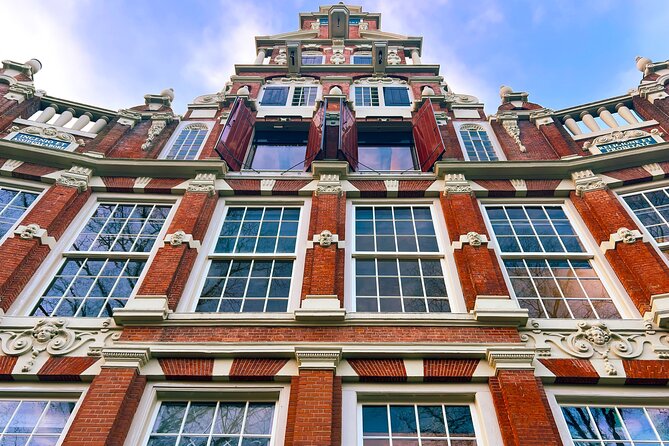
Next comes Huis Bartolotti, a 17th-century Dutch baroque house along the canals. This stop is quick, about 5 minutes, but it is packed with visual clues.
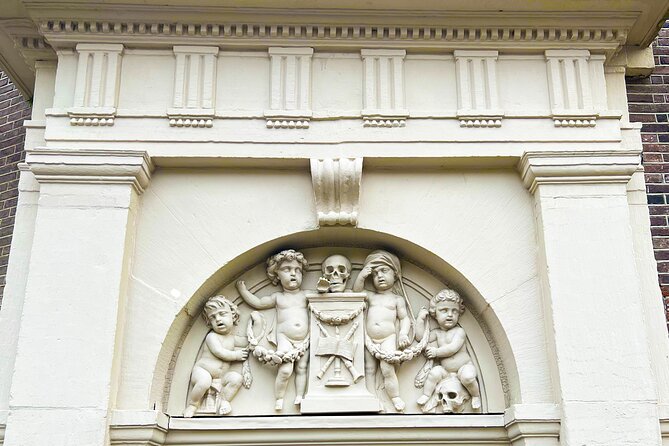
You focus on the contrast that makes baroque architecture feel theatrical even in a Dutch canal setting. The facade’s striking red brick, the large windows, and the ornate sandstone sculptural details are all signals of wealth. The guide also connects the house to the owner’s strong trading ties with Italy. That turns the building from a pretty landmark into a historical message in stone, saying, in effect, who had connections far beyond Amsterdam.
Why this stop matters for you: it trains your eye to notice symbolism and status markers. When you later see dolphin references, facade stones, or crooked house effects, it all starts clicking as part of the same Golden Age “language.”
A different way to spend an afternoon around Amsterdam:
- Amsterdam: Van Gogh Museum Ticket
★ 4.7 · 52,054 reviews - Amsterdam: Heineken Experience Ticket including 2 Drinks
★ 4.6 · 36,014 reviews - Amsterdam Classic Saloon Boat Cruise with Drinks and Cheese
★ 5.0 · 31,825 reviews - Amsterdam Luxury Canal Cruise + Unlimited Drinks & Bites option
★ 5.0 · 30,518 reviews
Torensluis bridge views: mercantile facades and crooked-house reality
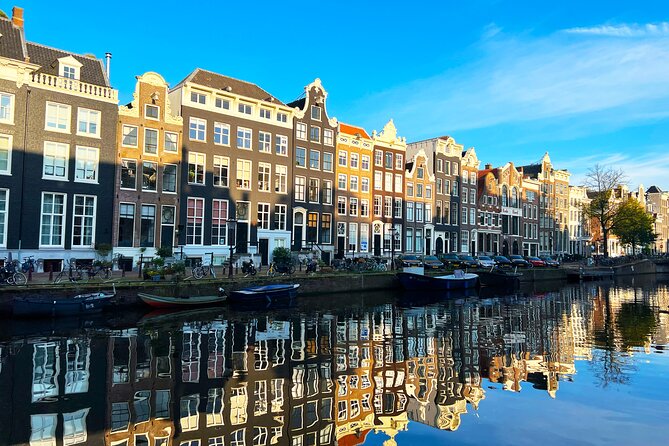
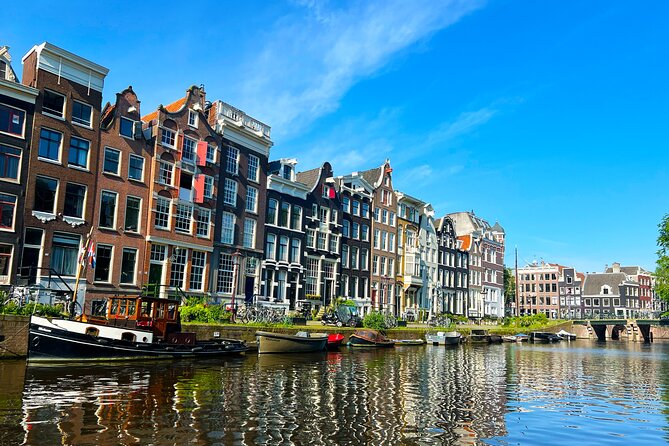
Stop 4: Torensluis is one of the tour’s best “look and explain” moments. From this wide bridge you can take in multiple facades and compare how the Baroque style got adapted in the Netherlands for mercantile needs.
The tour highlights four distinct façade designs that were popular with the merchant class. Even in 10 minutes, this is valuable because it teaches you what to look for: decorative rhythm, window proportions, and that unmistakable mix of comfort and power in the way these buildings face the water.
Then comes the Amsterdam quirk that is more than just a photo: crooked houses. You learn why some buildings lean and how Amsterdam’s soft, marshy ground shaped what was possible. This is not just “weird buildings.” It becomes a lesson in constraints, and why the city’s engineering and planning evolved as the city grew.
If you like architecture and you are the kind of person who zooms in on details while walking, this is a highlight. It also helps that a bridge gives you a stable viewing angle, rather than trying to read facades from street level where crowds can block your line of sight.
De Dolphijn and Rembrandt’s famous captain connection
At Stop 5: De Dolphijn, the guide ties a house name to a symbol of wealth, the dolphin. That matters because it is not random decoration. In the Dutch Golden Age, maritime trade shaped fortunes, and symbols like this acted like a shorthand for who you were and what you did.
You also get a Rembrandt connection. The original owner was Frans Banning Cocq, the captain immortalized in Rembrandt’s famous painting The Night Watch. When you link a painting-era figure to a specific canal house, Amsterdam history stops being abstract. It becomes map-specific.
Time here is short, about 5 minutes, but it is memorable because you leave with a fact pattern you can reuse while walking on your own. If you look at merchant houses later, you will start asking, What symbols are used here? What might they signal about trade, status, or profession?
Ronde Lutherse Kerk: domes, priorities, and a change in architectural mood
Stop 6: Ronde Lutherse Kerk is brief, about 5 minutes, and the key theme is simple: domes were a high point of architectural achievement during the Renaissance period. Even with limited time, this stop works because it reminds you that Amsterdam’s architecture does not stay locked in one style.
This is where the tour gives you contrast. You have been focused on merchant wealth, canal-belt baroque and neoclassical power, and then you get a church form associated with Renaissance ambition. It helps you understand the city as a sequence of ideas, not a single look.
If you are the type who enjoys architecture “transitions,” you will appreciate this quick pivot. If you only care about canal-belt houses, it may feel like a breather. Still, it prevents the walk from becoming one-note.
Prinsengracht warehouses: gables, windows, and hoisting beams for cargo
Stop 7: Prinsengracht is where the tour delivers on its Golden Age trade theme in a very practical way. The warehouses along the canal are iconic because they are functional architecture dressed for wealth.
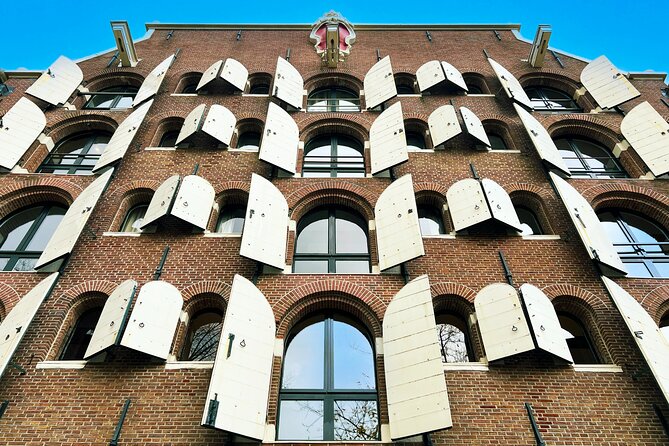
You are shown how these buildings were designed to move goods. Notice the tall, steeply pitched gables and large windows. On the roof area, the tour points out wooden hoisting beams used to lift heavy cargo from ships docked along the canal. That is the kind of detail that you almost never get from casual sightseeing, because it requires someone to explain why the architecture has those shapes.
The exteriors may feel simpler, with clean lines and less ornamentation. The purpose is the key here: efficient storage and easy loading. But the scale tells the other story. Big warehouses mean big money and high-volume trade.
Time at this stop is about 5 minutes, so you want to be ready to look fast. A good trick is to take one wide shot to capture the canal rhythm, then one close shot to capture a gable and roof detail. That way, even a short stop turns into something you remember.
Jordaan and gevelstenen: reading facade stones like clues
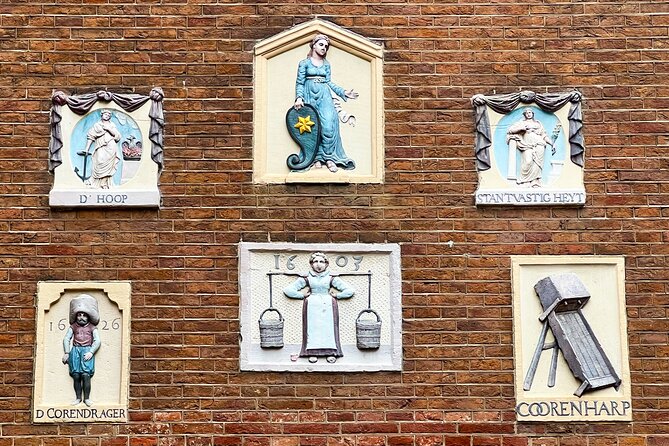
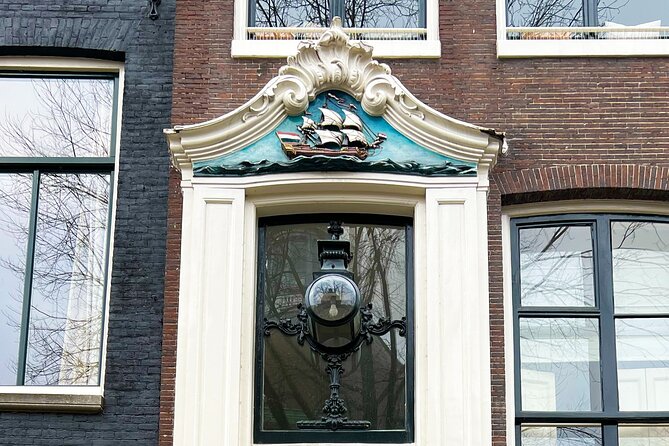
Stop 8: Jordaan lasts about 20 minutes, making it one of the most satisfying parts of the route. Here the tour zooms in on the neighborhood story and on the tiny architectural details called gevelstenen, which means facade stones.
In the 17th century, Jordaan was a mix of residential and commercial life. It developed for lower- and middle-class craftsmen and laborers, then grew into a busy district with narrow canals and rows of houses. Many had small shops or workshops on the ground floors. The tour’s focus on gevelstenen turns that street life into something you can actually read.
What you learn to look for is why these facade stones exist. They can be functional and decorative, but the real value is storytelling. They can communicate how the building was used, the profession of the owner, or other notable facts about people who lived and worked there. Many are carved with intricate designs. Even when you only see them briefly, they add meaning to the facades beyond style.
Practical advice: when you are standing in a canal neighborhood, slow down and scan upward. The best gevelstenen are often not at eye level for fast walkers. Take a moment to angle your head and look at the doorway and the space between windows.
Westerkerk: spire height, Rembrandt’s grave, and Anne Frank’s clock
The final stop, Stop 9: Westerkerk, is both a landmark and a closing scene. The tour ends near this church at Prinsengracht 279, close to the Anne Frank House area.
Westerkerk began as a Calvinist church, built to serve a growing population. You get the “Calvinist look” in the description: large, airy interior and simple, elegant design. The architecture fits the worship style, which helps you understand why some churches feel plain compared to others.
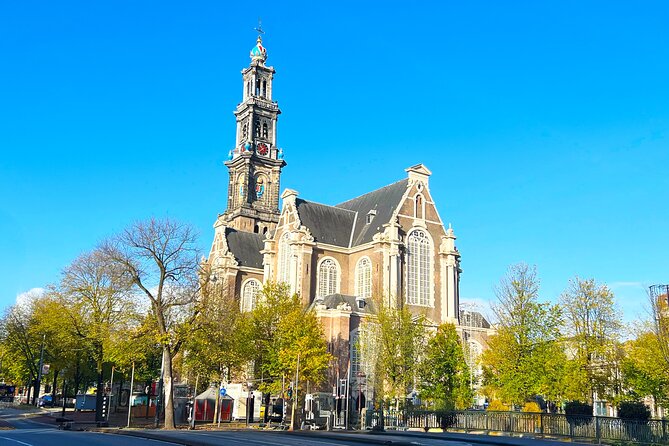
Then there are the big story anchors. Westerkerk is the final resting place of Rembrandt van Rijn. And the spire, completed in 1638, rises 85 meters, about 280 feet, above the Jordaan district. It is crowned with an imperial crown, a symbol tied to Amsterdam’s status since the 15th century.
Finally, the clock. The guide points out that the tower’s clock chimes are part of local memory, and Anne Frank mentioned them in her diary. That detail can feel surprising at the end of an architecture-focused tour. It turns timekeeping into another layer of heritage, as real and human as the buildings.
This stop is only about 5 minutes on the route, but it is one of those “stand there and look up” moments. If you end your tour feeling like you understand Amsterdam more, this is often why.
How to get the best from your 1.5-hour walk
Because the total time is about 1 hour 30 minutes, this tour works best when you treat it like a guided walking workshop. You will cover a lot of ground, with short stops and frequent transitions.
Here’s how to make it smoother and more fun:
- Wear comfortable shoes. You will be walking and standing in busy city areas for the duration.
- Bring a small bottle of water. Bottled water is not included.
- Take photos, but also look twice. Snap once, then re-check the facade details while you still understand what you are seeing.
- Ask questions when something feels confusing. The guide is used to turning architecture into plain explanations, and extra time for your curiosity is part of the point.
On route planning, you are close to public transportation. The tour start is at the Royal Palace area, and the finish near Westerkerk keeps you in the heart of the city for follow-on exploring.
If mobility is a concern, do not gloss over it. The tour is not recommended if you use a walker or have trouble walking and standing for 1.5 hours, and mobility aids are not available.
Should you book this Golden Age architecture walking tour with Anna?
Book it if you want Amsterdam’s canal-belt architecture to make sense fast. This is ideal if you like buildings but also like the “why” behind them: trade wealth, facade symbolism, and the engineering choices that made the city possible on soft ground. A private guide format is a real advantage, especially if you enjoy asking questions or want extra time on the details.
Skip it if you cannot comfortably manage about 1.5 hours of walking and standing, or if you need mobility aids. Also skip it if you want a long sit-down museum style experience. This is a street-level architecture walk with quick stops, not a slow deep dive through interiors.
If you are visiting Amsterdam for the first time, this can be a strong anchor tour. It gives you a framework you can carry into the rest of your days, from Prinsengracht warehouses to Jordaan facade stones to the Westerkerk spire above it all.
FAQ
How long is the walking tour?
The tour lasts about 1 hour 30 minutes.
Is this tour private?
Yes. It is a private tour/activity, and only your group participates.
What language is the tour offered in?
The tour is offered in English.
Where do I meet the guide, and where does the tour end?
The tour starts at Royal Palace Amsterdam, Nieuwezijds Voorburgwal 147, 1012 RJ Amsterdam. It ends near Westerkerk at Prinsengracht 279, 1016 DL Amsterdam, close to the Anne Frank House.
How much does the tour cost?
The price is $73.59 per person.
What is included in the price?
The included item is the private guide.
Are admission tickets required for the stops?
Admission tickets are listed as free at the stops in the itinerary.
Is bottled water included?
No. Bottled water is not included.
Is it suitable if I use a walker?
It is not recommended for participants who use a walker, or for those who have trouble walking and standing for 1.5 hours. Mobility aids are not available.
Newest bookings around Amsterdam
- Amsterdam Breakfast Cruise on Private Luxury Boat★ 5.0 · 5 reviews
- Amsterdam-West Food Tour with local guide★ 5.0 · 16 reviews
- Amsterdam: Explore the Van Gogh Museum & His Masterpieces★ 3.5 · 64 reviews
- Van Gogh Museum Tour excluding Entrance Tickets★ 5.0 · 16 reviews
- Van Gogh Museum with Audio Guide★ 3.5 · 80 reviews
- Van Gogh Museum Ticket with Audio Guide and Unlimited Access Time★ 5.0 · 25 reviews
- Van Gogh Museum Entry Ticket and Guided Tour★ 4.5 · 48 reviews
- Van Gogh Museum Private Tour★ 5.0 · 5 reviews
Walking Tours, compared.

Amsterdam Anne Frank: Small-Group Walking Tour & Local Guide
Read our review →
Anne Frank’s Story – Guided Walking Tour through Amsterdam
Read our review →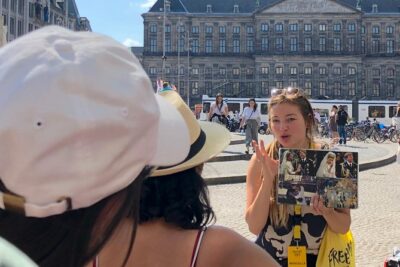
Absolutely Amsterdam – the Essential Introductory Walking Tour
Read our review →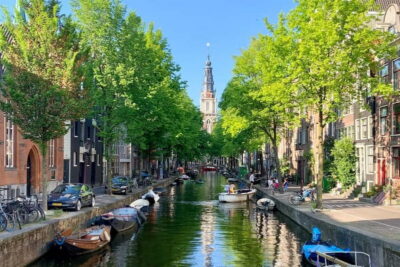
Anne Frank Guided Walking Tour in DE/EN/IT/ES
Read our review →
Anne Frank Walking Tour Amsterdam Including Jewish Cultural Quarter
Read our review →Browse the lists this tour appears in