
REVIEW · WALKING TOURS
Jewish Amsterdam Private Walking Tour
Jewish Amsterdam hits hard fast. This private walk in the Jewish Quarter uses a tight route, so you can focus on the people, not the crowds. I love the way the guide connects the streets you walk with the stories behind them, including the World War II and Holocaust context.
Two things I liked a lot: first, the tour is built for a small group (up to 4), which keeps the pace human and makes it easier to ask questions. Second, the stops mix major memorials with real community landmarks, so you get both tragedy and everyday Jewish life in the same morning block.
One drawback to plan around: ticketed museum time is not included for several key sites, and the Anne Frank House visit is optional. Construction closures also affect the Holocaust-related theater buildings, so you should expect to learn from the outside more than from interior exhibits.
In This Review
- Key things you should know before you go
- Private Jewish Quarter walking, without the crowd pressure
- Price and group size: what you’re really paying for
- Holocaust memorial stops that set the tone (Namenmonument to Auschwitz Monument)
- Hollandsche Schouwburg: what you learn when you cannot go inside
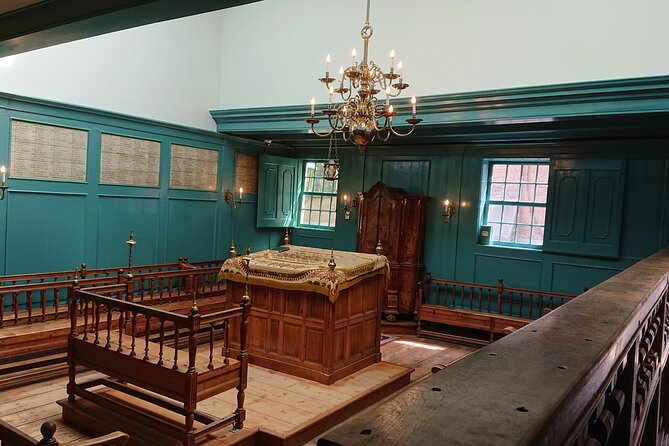
- Jewish Historical Museum and the Portuguese Synagogue: synagogue life and what tickets change
- Dockworker resistance memorial and the story behind everyday streets
- Spinoza’s Amsterdam, Rembrandt’s neighborhood, and a quieter kind of connection
- Uilenburgersjoel synagogue, flea market life, and memorials you might not expect
- Gassan and the diamond link: a practical detour that adds texture
- Anne Frank House: optional, ticket-dependent, and how to plan your day
- Who this tour fits best, and who should reconsider
- Should you book this Jewish Amsterdam tour?
- FAQ
- Is Anne Frank House included in the tour?
- Do I have to pay for museum tickets during the tour?
- Which stops have free admission?
- How long is the walking tour?
- What is the group size?
- Where do the tour and meeting end?
Key things you should know before you go
- Small-group, private format: maximum 4 travelers, typically booked well in advance.
- Holocaust memorials early: the walk starts at major remembrance sites to set context.
- Construction affects interiors: parts of the Hollandsche Schouwburg area are under construction through 2024.
- Several museums are extra-cost: Jewish Historical Museum, Portuguese Synagogue, Rembrandt House, and Anne Frank House are not included.
- Guide support can be strong: some guides help you with ticket access and show interior photos when needed.
- Walking is real walking: about 3.5 hours with limited-mobility considerations.
Private Jewish Quarter walking, without the crowd pressure
Amsterdam’s Jewish Quarter can feel busy in peak hours. This tour’s format helps you avoid that problem. Because it’s private and capped at 4 people, you get a calmer rhythm at each stop. You can listen closely, take a photo without shoulder-checking strangers, and actually absorb what you’re seeing.
You also get an end-to-end route that stays in one area rather than chopping across the city. That matters because so many of the stops are emotionally heavy. When you’re not spending time in transit, you can mentally stay with the theme as the guide moves from memorials, to synagogue life, to remembrance and resistance.
More Walking Tours in Amsterdam
- Amsterdam Anne Frank: Small-Group Walking Tour & Local Guide
★ 4.8 · 12,789 reviews - Anne Frank’s Story – Guided Walking Tour through Amsterdam
★ 5.0 · 11,619 reviews - Absolutely Amsterdam – the Essential Introductory Walking Tour
★ 5.0 · 3,629 reviews
Price and group size: what you’re really paying for
At about $540.69 per group (up to 4), the cost sounds high if you compare it to a big bus tour. But the math changes fast when you split it. You’re not paying for volume. You’re paying for a guide, a focused walking route, and the flexibility to adjust pacing.
The group cap is a big part of the value. In practice, it means fewer interruptions, more time at each site (most stops are around 5 to 15 minutes), and a better chance you’ll get answers instead of a one-way lecture. The tour also offers pickup, which can reduce friction on a day when you’re trying to hit several memorial sites.
Holocaust memorial stops that set the tone (Namenmonument to Auschwitz Monument)
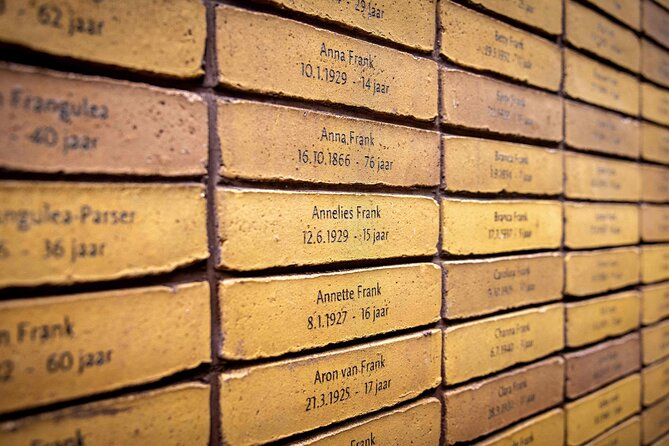
The tour starts with remembrance at a memorial bearing the names of 102,000 people who died in Nazi camps of death and were not given a proper burial. This is the kind of stop that gives you the first “how to look” lesson of the whole walk: you’re not just seeing a monument, you’re reading a system of loss.
Next comes the Auschwitz Monument, featuring broken glass and honoring approximately million victims of Auschwitz. Even with the missing number in the wording you’ll see online, the message is clear. The broken-glass element is meant to shock, but also to communicate how violence spreads into everything, even the physical world around you.
These early minutes work best if you treat them like a pause, not a checkbox. Give yourself time to stand still, look, and let the guide frame what you’re about to see in the Jewish Quarter.
Hollandsche Schouwburg: what you learn when you cannot go inside
One of the most important parts of planning is this: the Hollandsche Schouwburg area (also known as the Dutch Theater and Holocaust Memorial building) is under construction until 2024. That means the tour treats these buildings as stop points, but you won’t be doing a full interior visit.
Even though you can’t enter, this stop still matters. The guide’s personal approach is to use meaning and background, and to show personal photo material to explain what those spaces were used for and why the buildings are tied to Holocaust events. That’s a useful style of guiding when interiors are unavailable. You still get the story, but it becomes more about context and interpretation than museum-style browsing.
If you’re visiting with someone who really wants indoor exhibits, this is the one section where you might feel a bit shortchanged. On the other hand, if you want the “why does this building matter” explanation, this stop can land hard.
A different way to spend an afternoon around Amsterdam:
- Amsterdam: Van Gogh Museum Ticket
★ 4.7 · 52,054 reviews - Amsterdam: Heineken Experience Ticket including 2 Drinks
★ 4.6 · 36,014 reviews - Amsterdam Classic Saloon Boat Cruise with Drinks and Cheese
★ 5.0 · 31,825 reviews - Amsterdam Luxury Canal Cruise + Unlimited Drinks & Bites option
★ 5.0 · 30,518 reviews
Jewish Historical Museum and the Portuguese Synagogue: synagogue life and what tickets change
The tour then moves into the heart of Jewish community landmarks, including two related synagogue sites.
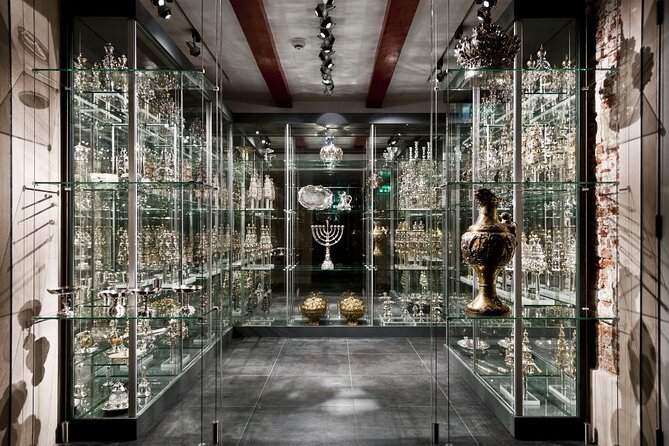
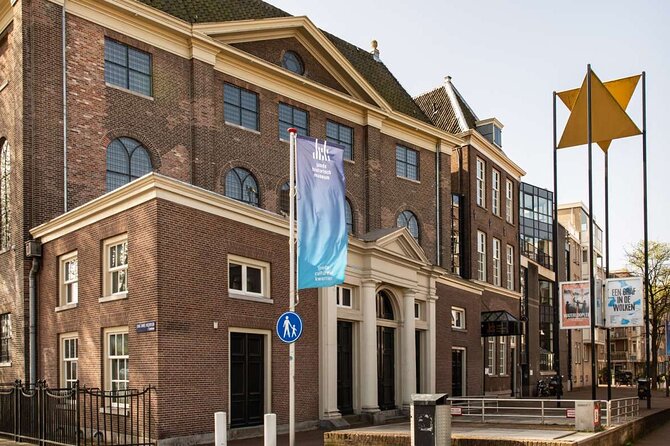
First, there’s the Jewish Historical Museum and its Children’s Museum, housed in a group of four historical Ashkenazi synagogues. The key point for you: this is a ticketed add-on, not included. The stop time is short (around 10 minutes), so even if you’re interested, this is more about orientation than a full museum experience.
Then you’ll also see the Portuguese Synagogue, also called Snoge or Esnoga. It’s a Sephardic synagogue from 1675 and is noted as one of the oldest Portuguese Jewish synagogues in Europe that is still in use.
Here’s the practical reality: if you arrive without museum stamina, you can still learn a lot from the outside and the guide’s context. But if you truly want to see interiors, plan to budget extra and manage time carefully. In one account tied to this tour style, the guide brought photos to show what the interior spaces look like when entry was not possible. That’s a smart backup strategy, and it’s worth watching for if your own timing gets tight.
Dockworker resistance memorial and the story behind everyday streets
Not all the heavy moments come from big named institutions. Some come from small reminders in plain sight.
The walk includes Dokwerker, a dockworker statue honoring protest against anti-Semitic policies by Nazi occupants and the first deportations of Jews to the concentration camp at Mauthausen on February 24, 1941. This matters because it shows resistance was not abstract. People tried, spoke, and acted. Even when history crushed them, their refusal to accept injustice left a trace you can stand next to.
This is also a good moment to slow down your pacing. The statue is quick (about 10 minutes), but the subject invites reflection. If you’re the type who likes to connect monuments to the geography around them, this stop is one of the best setups on the route.
Spinoza’s Amsterdam, Rembrandt’s neighborhood, and a quieter kind of connection
One highlight for me is how the route mixes Jewish memorials with Amsterdam’s wider cultural map.
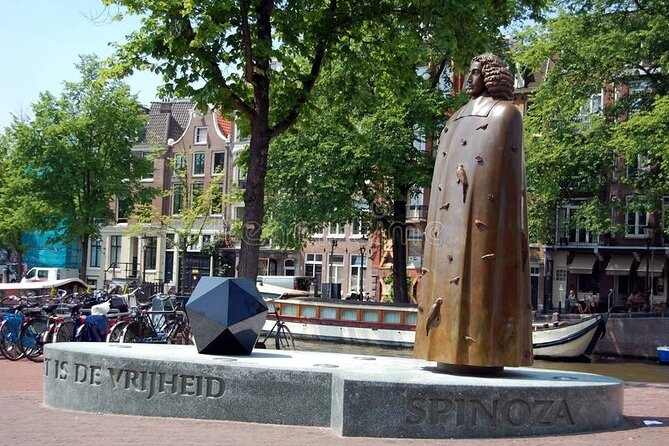
You’ll pass a 19th-century Catholic Church that once was the residence site of Jewish philosopher Baruch Spinoza and his family. That detail helps you see that this story is not sealed in one neighborhood. It’s woven into the city’s intellectual and social life.
The tour also includes Huis de Pinto, a house from 1603 once owned by wealthy Jewish merchant Isaac de Pinto. Small stops like this are easy to skim. Don’t. A stop like this is how you learn the texture of past streets, where wealth, community life, and ideas all sat within walking distance.
Then there’s Rembrandt House Museum, tied to Rembrandt’s years living in Amsterdam from 1639 until 1658. The tour notes the connection between his life and Amsterdam’s Jewish community. But again, this is ticketed and not included. Expect this stop to function as a guided pointer, not a full museum visit.
If you want a smooth day, treat Rembrandt House as an optional bonus that you decide later, depending on your energy and your interests in art history versus strict memorial focus.
Uilenburgersjoel synagogue, flea market life, and memorials you might not expect
As the walk continues, you’ll hit landmarks that feel more like everyday Amsterdam, which is exactly why they matter.
The tour includes Uilenburgersjoel, a historic Rococo-style synagogue erected in 1766 for Ashkenazi Jews. The stop is brief, but it signals a timeline. Amsterdam’s Jewish community was not only present in the 20th-century story. The architecture gives you a sense of how long the community shaped the city.
You’ll also see Waterlooplein Market, described as Amsterdam’s oldest flea market (with social life continuing until WWII). The stop time is around 15 minutes, and the memorial weight of the earlier sites makes this feel like a contrast tool. It reminds you that community life was normal, crowded, and human before it was targeted.
Another short remembrance stop is the Deaf Memorial, in memory of Jewish deaf victims of the Nazi regime from 1940 to 1945. This is a specific angle that many visitors miss, and it’s powerful because it widens the lens beyond the most commonly named categories.
Finally, there’s the Spinoza Monument and the Monument vor Joods verzet (Jewish resistance). Together, they balance the walk: one points to ideas that outlast oppression, and the other points to people who resisted and died for it.
Gassan and the diamond link: a practical detour that adds texture
The route includes GASSAN, a museum, workshop, and store connected to the famous diamond family company. The visit time is about 20 minutes, and it’s described as free to enter with local company guidance available.
This is not a detour for everyone. But for many visitors, it helps the day breathe. After multiple WWII and Holocaust memorial sites, a place connected to craftsmanship and trade offers a different kind of history, one that feels closer to the Amsterdam you can still visit today.
Anne Frank House: optional, ticket-dependent, and how to plan your day
This is the part where you must read carefully and plan with your eyes open.
The tour does not include the Anne Frank House Museum visit. Even though the meeting point and ending point are near the Anne Frank House area, the actual museum tickets are not included. Your guide can assist regarding availability and ticket guidance, but the guide cannot obtain the tickets personally.
In practice, this changes how you should structure your afternoon. If you want to visit Anne Frank House on the same day, build in time for ticket lines, timed entry, and the chance that access depends on availability.
The good news: in accounts linked to this tour style, the guide coordinated timing so entry could work. The guide met people outside after the house visit and helped them understand how to get back. That kind of hands-on support is worth its weight when you are already mentally drained from memorial stops.
One more planning note: some stops that are commonly paired with this route in other contexts (like Jewish Historical Museum interiors) may also be ticketed. So you’ll want to decide early what you want to see inside versus what you’re happy learning from outside.
Who this tour fits best, and who should reconsider
This tour is best for you if you want a small-group walking route through Jewish Amsterdam with a clear WWII and Holocaust learning thread. It also suits you if you like practical guidance from a guide who communicates and adjusts to real-world timing.
It’s also a good fit for visitors who appreciate photos and explanations when interior visits are unavailable. Construction closures at the Hollandsche Schouwburg buildings through 2024 mean you’re getting guided interpretation, not a full museum circuit.
Consider a different choice if you know you have very limited mobility. The walk is at least about 3.5 hours, with the option for breaks and a pace adjustment, but the route still covers a lot of ground and includes emotionally heavy stops that ask you to stand and pay attention.
Should you book this Jewish Amsterdam tour?
I think you should book it if you want something more focused than a general city walk, and you value a route that connects major memorials with Jewish community landmarks. The private, crowd-free feel is real value here, not just marketing language.
Book with extra care if your top goal is inside access. Several sites are not included and the Anne Frank House visit is optional and ticket-based. If you can handle that with planning, you’ll get a day that feels coherent and deeply meaningful.
If your heart is set on Anne Frank House plus multiple museum interiors, consider booking this as the “foundation walk,” then adding the specific interior visits you care about most. That way you don’t overload the day, and you keep your attention where it counts.
FAQ
Is Anne Frank House included in the tour?
No. The tour does not include the Anne Frank House Museum visit. Your guide can help with information about availability and ticket timing, but tickets are not included in the tour price.
Do I have to pay for museum tickets during the tour?
Yes. The Jewish Historical Museum and Portuguese Synagogue (Snoge/Esnoga) require a combined ticket that is not included. Rembrandt House Museum is also not included. Admission for these stops is listed as not included, so plan extra costs if you want to enter.
Which stops have free admission?
Several memorial and monument stops are marked as admission ticket free, including the Holocaust Namenmonument, Auschwitz Monument, Dokwerker, Uilenburgersjoel, Huis De Pinto, Waterlooplein Market, Deaf Memorial, Spinoza Monument, and Monument vor Joods verzet. Other stops have ticketed entries.
How long is the walking tour?
It runs about 3 hours 30 minutes (approx.).
What is the group size?
The tour maximum is 4 travelers.
Where do the tour and meeting end?
Start: Passenger Terminal Amsterdam, Piet Heinkade 27, 1019 BR Amsterdam. End: near the Anne Frank House area, at Westermarkt 20, 1016 GV Amsterdam, with the meeting point described as beside the Western Church on Prinsengracht.
Newest bookings around Amsterdam
- Amsterdam Breakfast Cruise on Private Luxury Boat★ 5.0 · 5 reviews
- Amsterdam-West Food Tour with local guide★ 5.0 · 16 reviews
- Van Gogh Museum Tour excluding Entrance Tickets★ 5.0 · 16 reviews
- Van Gogh Museum with Audio Guide★ 3.5 · 80 reviews
- Amsterdam: Explore the Van Gogh Museum & His Masterpieces★ 3.5 · 64 reviews
- Van Gogh Museum Ticket with Audio Guide and Unlimited Access Time★ 5.0 · 25 reviews
- Van Gogh Museum Entry Ticket and Guided Tour★ 4.5 · 48 reviews
- Van Gogh Museum Private Tour★ 5.0 · 5 reviews
Walking Tours, compared.

Amsterdam Anne Frank: Small-Group Walking Tour & Local Guide
Read our review →
Anne Frank’s Story – Guided Walking Tour through Amsterdam
Read our review →
Absolutely Amsterdam – the Essential Introductory Walking Tour
Read our review →
Anne Frank Guided Walking Tour in DE/EN/IT/ES
Read our review →
Anne Frank Walking Tour Amsterdam Including Jewish Cultural Quarter
Read our review →Browse the lists this tour appears in