
REVIEW · WALKING TOURS
The Hague: Mystery Figures Walking Tour
Science in The Hague can feel like a mystery. This walking tour turns the streets into an interactive math and science game, with a guide and a tablet that helps you see how key ideas shaped places you walk past. You start at the Escher in Het Paleis area, then stitch together 10 story stops into one bigger puzzle.
I especially love how hands-on the format is, not just lectures. You solve a secret numerical code to earn a unique souvenir, and the clues are built around real scientific thinkers you will hear about on the route. My other favorite part is the mix of big names like Spinoza with practical tools like reading sundials, number systems, and scientific instruments.
One thing to keep in mind: the Escher museum entrance is not included, so plan on tour time only, not a full museum visit. If you want mostly artwork or a long seated history talk, this format may feel more active than you expect.
In This Review
- Key things to know before you go
- Meeting at Escher in Het Paleis, then getting your mystery brief
- Voorhout and the Paleistuin stops, how the clues start simple
- Binnenhof, where civic power meets measurement
- Chinatown The Hague and the longer pause for storytelling
- The 10 hidden stops, and what they teach beyond the names
- Cracking the numerical code and earning the souvenir
- Walking route, pace, and what 3 kilometers feels like
- Value check: is $29 worth it for a 2-hour interactive science tour?
- Who this tour suits best, and who should skip it
- Should you book the Mystery Figures Walking Tour in The Hague?
- FAQ
- What is the duration of the The Hague: Mystery Figures Walking Tour?
- Where do I meet my guide?
- Is the Escher museum entrance included?
- How long is the walk?
- What languages are offered?
- Do I need a calculator to solve the code?
- What do I get at the end?
- Is the tour wheelchair accessible?
- What is the minimum age?
- Can I cancel, and is there a reserve now pay later option?
Key things to know before you go
- Tablet-led stops with photos, videos, and simulations to make the past feel concrete.
- 10 interactive mystery stops focused on math, science, and the people behind them.
- A numerical code that you crack during the walk for a unique souvenir at the end.
- Sundials and number systems taught in plain language, no calculator needed.
- About 3 km total, paced for about 90 to 120 minutes depending on how fast your group goes.
Meeting at Escher in Het Paleis, then getting your mystery brief
You begin in front of the Escher in Het Paleis museum, which is a smart start point because it immediately sets a creative mood. From there, your guide frames the walk as a series of science clues, not a straight line of facts. The whole thing is designed so you are looking outward at the city, then inward at the puzzle.
What helps most is that you are not on your own with a worksheet. You follow along with a local expert, with Dutch or English delivery, and you get visual support from a tablet. That tablet element matters for two reasons: it keeps the stops moving, and it helps you connect what you see on the street with what used to be there.
If you have done plenty of walking tours before, you might expect photo breaks and a few quick stories. This one is different because the guide uses the screen to show context, including simulations of The Hague from centuries ago. It is still a walk, but it feels closer to a guided mission.
More Walking Tours in The Hague
- The Hague: City Walking Tour
★ 4.5 · 156 reviews - The Hague: Old City Private Walking Tour
★ 4.4 · 81 reviews - The Hague 2-Hour Walking Tour | Discover The City With A Local
★ 4.5 · 81 reviews
Voorhout and the Paleistuin stops, how the clues start simple
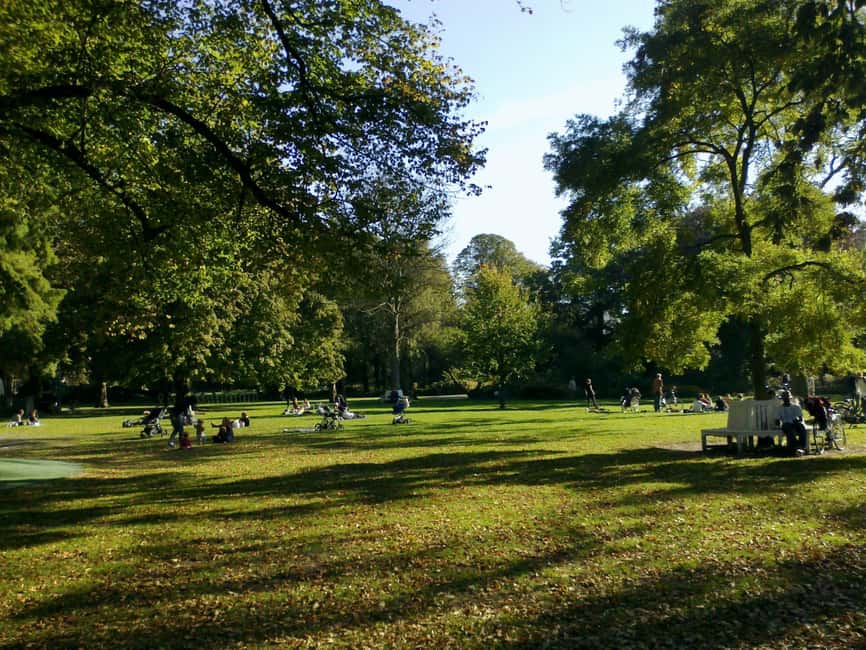
Early on, you will hit Voorhout and the Paleistuin with short guided pauses. These stops are where the tour teaches you how to think like the puzzle maker. Expect short explanations that set up what you will do later, instead of spending all your time in one single spot.
This is also where the math and science angle becomes practical. You are not just hearing names of theories and dates. You are picking up tools for the code and learning how certain objects and markings in the city connect back to number systems, measurement, and interpretation.
A bonus here is pacing. Those first stops are time-boxed, so you are not dragged into a long monologue before you even get your bearings. You learn the style of the tour quickly, then you start accumulating clues while the walk keeps going.
Binnenhof, where civic power meets measurement
Next up is a stop at the Binnenhof area, again with a brief guided segment. This is a great location for science storytelling because civic buildings naturally connect to systems: calendars, measurement, planning, and governance. The tour uses that setting to show how science shows up in everyday decision-making, not just in laboratories.
The best part of the Binnenhof stop is the way the guide links ideas to the city itself. You start paying attention to details that are easy to miss if you are just sightseeing. Even without turning this into a technical lecture, you learn how instruments and ways of counting influence what gets built and how people organize time.
You should expect questions and interaction, not just listening. If you like to think while walking, this is where you will feel the tour clicking. If puzzles stress you out, you can still follow along with the group, but it helps to lean into the playful side of it.
Chinatown The Hague and the longer pause for storytelling
One of the longer segments comes around Chinatown in The Hague, where you get about a half hour of guided time. This is likely when your guide adds depth to the mystery thread, tying scientific figures and themes to what you see in the neighborhood.
I like this setup because it gives you a breather. A long stop also means you get time for photos, and it is a good moment to slow down and actually look around rather than rush to the next clue. The city setting helps, too. You get variety on the route, so the tour does not feel like it is only focused on one type of architecture.
This Chinatown stop is also where you will likely notice how the tablet supports the narrative. When the guide switches to images, videos, or simulations, it helps you place stories in time. That is especially useful if you are learning about centuries-old scientific thinking but you are seeing modern streets.
A different way to spend an afternoon around The Hague:
- The Hague: Mauritshuis Entrance Ticket
★ 4.7 · 2,706 reviews - The Hague: Madurodam Miniature Park Entry Ticket
★ 4.6 · 1,559 reviews - The Hague: The Pier SkyView Ticket with Drink and Snack
★ 4.4 · 1,398 reviews - The Hague: Hop-on Hop-off Heritage Tram Tour
★ 4.5 · 1,311 reviews
The 10 hidden stops, and what they teach beyond the names
The tour is built around 10 stops, and the content is framed around mathematics and science themes. Along the way, you will encounter topics like number systems and scientific instruments, plus stories tied to figures such as Fahrenheit, Spinoza, and Huygens.
Here is why that approach is valuable. If you only hear biographies, science history can feel like a parade of famous people. If you only hear about instruments, it can feel like a museum display with no story. This tour tries to connect the two by showing how measurement and counting influence real life, including topics the guide frames through life and death.
You should also understand the tour’s promise here: it is interactive. You will be solving clues during the walk, not at the end when you are tired. That means each stop has a job in the larger puzzle.
Depending on your group pace, you should plan on about 90 to 120 minutes total for the walk. You are covering around 3 kilometers, so you will be outside for long enough to feel like you saw the city, but not so long that it becomes an endurance test.
Cracking the numerical code and earning the souvenir
The code moment is the payoff. You work through clues during the walk, then you crack a numerical code as part of the experience. When you finish, you earn a unique souvenir, which gives the tour a strong sense of closure.
The good news: you do not need to bring a calculator. The tour is designed to be solvable with what you learn from the guide’s explanations and what you observe on the route. That detail matters because it lowers the barrier for people who worry about math.
This also affects the group energy. When everyone is solving the same code, you do not have to be the fastest thinker. You just need to listen and participate. I especially like that because it makes the tour friendly for families who meet the age minimum, as well as for mixed groups with different comfort levels.
One more practical tip: bring your attention. This is a puzzle tour. If you treat it like a slideshow while wandering on autopilot, the code will feel harder than it needs to.
Walking route, pace, and what 3 kilometers feels like
The walk is about 3 kilometers and generally lands in that 90 to 120 minute window. That pacing makes it ideal for a half-day plan where you still want time to wander on your own later. You are also not stuck in one spot long enough to get bored, but you get enough time at key stops to actually absorb what the guide is connecting.
You also need to plan for weather, since this is a street-level tour. In The Hague, conditions can change fast, so a light layer helps. Wear shoes you trust on city sidewalks, because you will be moving throughout the entire experience.
If you have slower walkers in your group, there is a built-in advantage. One guide named Rowdy is described as friendly, flexible with group timing, and strong at keeping older relatives engaged even with a more relaxed pace. That is a good sign that the tour can handle different comfort levels without turning into a race.
Value check: is $29 worth it for a 2-hour interactive science tour?
At $29 per person for about 2 hours, this sits in the range where you want to ask what you get beyond sightseeing. The answer is structure plus interaction. You get 10 stops, expert guidance in Dutch or English, and a tablet element that supports the stories. You also get a numerical code challenge that ends in a physical souvenir.
The value improves if you like learning that sticks. The tour teaches math and science through walking observations, then connects it to real historical figures. That is very different from a traditional city talk, where you might remember one or two highlights and forget the rest.
Is it worth it if you are not a puzzle person? The tour still provides city context and science stories, but the code is part of the experience, so it helps if you are willing to play along. It is not a silent audio tour where you tune out between facts.
Overall, if your goal is to see The Hague through a math-and-science lens, you are paying for guided learning plus an ending you can take home.
Who this tour suits best, and who should skip it
This walking tour is a strong match if you like:
- Learning ideas you can apply while you walk
- City details that connect to history through numbers, instruments, and timekeeping
- Interactive guides who use a tablet for images and simulations
It is also designed for ages 12 and up, and it is not suitable for children under 12. If you are traveling with teens and want something smarter than a standard sightseeing loop, this fits nicely.
It is wheelchair accessible, which is a big plus for planning. You will still be outdoors and walking a route, but the tour is stated to be accessible. If you need accommodations, it is best to contact the provider to confirm details for your specific mobility needs.
If you prefer only museum time, this might not satisfy you on its own, because the Escher museum entrance is not included. Think of this as a guided street-based learning experience.
Should you book the Mystery Figures Walking Tour in The Hague?
Book it if you want The Hague to feel different from the usual highlights. The combination of a local guide, tablet-based visual context, and a numerical code challenge makes this more than a walk with stories. At $29 for about 2 hours and roughly 3 kilometers, the math and science angle is delivered in a way that stays engaging from stop to stop.
Skip it if your ideal tour is mostly quiet viewing, long museum time, or no interaction. The code and the guided puzzle structure are central, so your enjoyment will rise if you are willing to participate.
If you are curious about figures like Fahrenheit, Spinoza, and Huygens, and you like learning through the city’s details rather than just reading plaques, this one is a great choice.
FAQ
What is the duration of the The Hague: Mystery Figures Walking Tour?
The tour takes about 2 hours, and the actual time can run between 90 and 120 minutes depending on the group pace.
Where do I meet my guide?
You meet in front of the Escher museum, Escher in Het Paleis.
Is the Escher museum entrance included?
No. The tour does not include entrance to The Escher museum.
How long is the walk?
The tour is about 3 kilometers long.
What languages are offered?
The tour is available in Dutch and English.
Do I need a calculator to solve the code?
No calculator is needed.
What do I get at the end?
You crack a numerical code and earn a unique souvenir at the end of the tour.
Is the tour wheelchair accessible?
Yes, it is wheelchair accessible.
What is the minimum age?
It is not suitable for children under 12.
Can I cancel, and is there a reserve now pay later option?
Free cancellation is available up to 24 hours in advance for a full refund, and you can reserve now and pay later to keep your plans flexible.
Newest bookings around The Hague
- The Hague Walking Tour★ 4.5 · 16 reviews
- The Hague: Powerboat Tour Scheveningen★ 4.5 · 15 reviews
- The Hague: Private Boattour up to 10 persons★ 4.9 · 37 reviews
- The Hague: Private Custom Walking Tour With A Local Guide★ 4.5 · 13 reviews
- The Hague: The Hague Tower climb Guided Tour★ 4.6 · 52 reviews
- The Hague: individual tickets for an electric boattour!★ 4.8 · 57 reviews
- The Hague: Ping Pong Table Rental at a Secret Ping Pong Bar★ 4.5 · 7 reviews
- The Hague: Museum Beelden aan Zee Entry Ticket★ 4.4 · 6 reviews
Walking Tours, compared.
Amsterdam Anne Frank: Small-Group Walking Tour & Local Guide
Read our review →
Anne Frank’s Story – Guided Walking Tour through Amsterdam
Read our review →
Absolutely Amsterdam – the Essential Introductory Walking Tour
Read our review →
Anne Frank Guided Walking Tour in DE/EN/IT/ES
Read our review →


Anne Frank Walking Tour Amsterdam Including Jewish Cultural Quarter
Read our review →Browse the lists this tour appears in