
REVIEW · WALKING TOURS
Historical Walking Tour, private with local Dutch guide
Amsterdam makes sense on foot. This private 2-hour walk with local guide Anna uses medieval leftovers, merchant-era streets, and canal views to help you read the city fast. You get a tour that also aims at the Amsterdam most visitors miss, not just the postcard hits.
Two things I like a lot are the clear pacing and the way Anna’s dry wit keeps heavy history from feeling like homework. I also appreciate that the storytelling feels personal, with room to follow your interests and ask questions. One drawback to plan around: it is a steady 2-hour walk with standing, and there are no mobility aids available.
In This Review
- Key highlights at a glance
- From Weeping Tower to Westerkerk: how this route helps you read Amsterdam
- Why a private Dutch guide like Anna changes everything
- Stop-by-stop: what you’ll see, and what each place teaches you
- Stop 1: Weeping Tower (Schreiertoren)
- Stop 2: Zeedijk
- Stop 3: The Waag
- Stop 4: Oostindisch Huis (Dutch East India Company)
- Stop 5: Het Kleinste Huis van Amsterdam
- Stop 6: Dam Square
- Stop 7: Canal Ring (Grachtengordel)
- Stop 8: Jordaan
- Stop 9: Westerkerk
- The Canal Ring and Jordaan block: how to make the most of your 60 minutes
- Price and value: what $96.02 buys in Amsterdam
- Getting there and comfort notes that actually matter
- Who should book this, and who might skip it
- Should you book this historical walking tour?
- FAQ
- How long is the private historical walking tour?
- Is the tour private or shared?
- What language is the tour offered in?
- Where do we meet and where does it end?
- Are admission tickets included for the stops?
- Is bottled water included?
- Is the tour suitable for people who use a walker?
- Are service animals allowed?
- What is the cancellation window?
Key highlights at a glance
- Local perspective from Anna, who has lived in Amsterdam for about 25 years
- Private group time, so your questions and pace matter
- Stop by stop context, from medieval defenses to the VOC spice trade
- Canal Ring and Jordaan focus, including houseboats and brown cafes
- Service animals welcome
- Free admissions at each listed stop, plus all fees and taxes handled
From Weeping Tower to Westerkerk: how this route helps you read Amsterdam
This tour is a smart first move if you’re new to Amsterdam. It starts at Café the Schreiertower on Prins Hendrikkade and ends in the Westerkerk area on Prinsengracht, close to the Anne Frank House and the church itself. That ending point is handy because you can keep walking into the canal belt on your own right after the tour.
You’ll cover a wide slice of the city center without feeling like you’re racing. The route is built to connect big themes: how the city protected itself from flooding, how merchants shaped the streets and canals, and how later power moved through trade. It is also timed well, with several quick stops and then longer stretches where you can actually look around.
Another reason I’d pick this for your first Amsterdam day is that it ends at a place locals love. Westerkerk is described as a Dutch Protestant landmark with a stylish design and an iconic spire, and you get a quick, focused moment there. In practical terms, it gives you a clean visual “anchor” for your next walk.
More History Tours in Amsterdam
- Amsterdam Food and Cultural Tour with Tastings
★ 5.0 · 4,315 reviews - Amsterdam: Historic City Centre Canal Cruise
★ 4.3 · 659 reviews - Amsterdam: Haunted History and Ghost Walking Tour
★ 4.5 · 488 reviews
Why a private Dutch guide like Anna changes everything
This is a private tour, meaning it is only your group. That matters in a city where streets are busy and questions pop up constantly, especially when you start noticing the details. With a private format, Anna can shift the emphasis to what you care about, instead of running a fixed script for a large group.
The reviews you provided also point to Anna’s communication style. Expect friendly confidence, great English, and a sense of humor that is described as dry. That combination is useful because Amsterdam history often jumps between politics, trade, and everyday life, and you want someone who can keep it understandable.
Pacing is another plus. The tour keeps you on track so you see the planned highlights, but it is not a “no questions” kind of walk. You can ask, pause, and get answers, which makes the whole route feel more like a conversation than a lecture.
Stop-by-stop: what you’ll see, and what each place teaches you
This tour moves in short segments, with most stops around five minutes, plus a couple longer blocks for the neighborhoods that matter. Each listed site is marked as admission ticket free, so you are paying for the guide’s storytelling, not for building entry fees.
Also, one of the most valuable parts is how the guide links architecture and street layout to larger events. You’re not just seeing pretty buildings. You’re learning why the city grew the way it did.
Stop 1: Weeping Tower (Schreiertoren)
You meet at the Weeping Tower, a medieval watchtower and one of Amsterdam’s few middle-age remnants. This is a great opening because it immediately sets the idea that Amsterdam has layers, and you can still spot the earliest ones if you know where to look.
The guide also explains the origins of Amsterdam right here. That matters because later stops make more sense when you understand how the settlement formed before the Golden Age merchant boom.
More Walking Tours in Amsterdam
- Amsterdam Anne Frank: Small-Group Walking Tour & Local Guide
★ 4.8 · 12,789 reviews - Anne Frank’s Story – Guided Walking Tour through Amsterdam
★ 5.0 · 11,619 reviews - Absolutely Amsterdam – the Essential Introductory Walking Tour
★ 5.0 · 3,629 reviews - Amsterdam: Anne Frank Guided Walking Tour in DE/EN/IT/ES
★ 4.9 · 3,107 reviews
Stop 2: Zeedijk
Next comes Zeedijk, one of the city’s oldest streets. The key detail is that it functioned as a dike with locks, protecting Amsterdam from flooding.
When you know that, you start noticing how “street” and “water system” overlap in Amsterdam. You’ll look at the ground level a little differently after this, because the city’s infrastructure is part of its identity, not just background.
Stop 3: The Waag
At The Waag, you get a medieval city gate that used to be part of a defensive wall and moat system. This stop connects the earlier defensive story to Amsterdam’s role as a protected urban space.
It’s also a useful “bridge” between eras. From watchtower and dike, you move into the idea of controlled access, defense, and city organization before trade power takes over.
Stop 4: Oostindisch Huis (Dutch East India Company)
This is a standout stop for anyone who likes big turning points. The Oostindisch Huis was a former office and warehouse of the Dutch East India Company, founded in 1602. Anna explains the history of the spice trade, and also how this connects to the invention of the modern corporation and stock market.
Even if you do not care about finance, this is an Amsterdam-essential theme. Merchant wealth shaped the city, and trade changed the world-view of the people building these neighborhoods. You’ll leave with a clearer sense that Amsterdam’s canals and architecture were not just pretty ideas, they were tied to economic power.
Stop 5: Het Kleinste Huis van Amsterdam
Now you get a reminder that Amsterdam’s streets were always full of practical, human scale realities. Het Kleinste Huis van Amsterdam is described as the city’s smallest house, standing near a gate decorated with the city crest and symbolic decorations.
This is one of those stops where you feel the difference between grand stories and everyday life. It also nudges you to look at facades with curiosity instead of rushing past.
Stop 6: Dam Square
Dam Square is the old market square, described as the heart of the city. Today, it is the location of the Royal Palace and the national Second World War monument.
This is a good place to take in the city as a whole, because it sits at the center of your walking network. The guide’s context can also help you see why this square matters beyond one single sight, especially once you move into the canal belt.
Stop 7: Canal Ring (Grachtengordel)
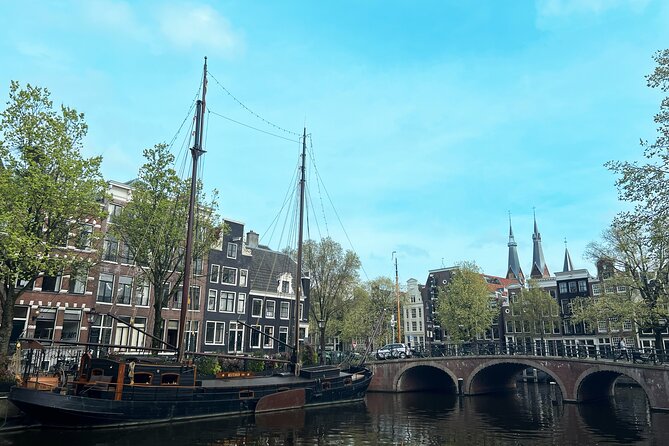
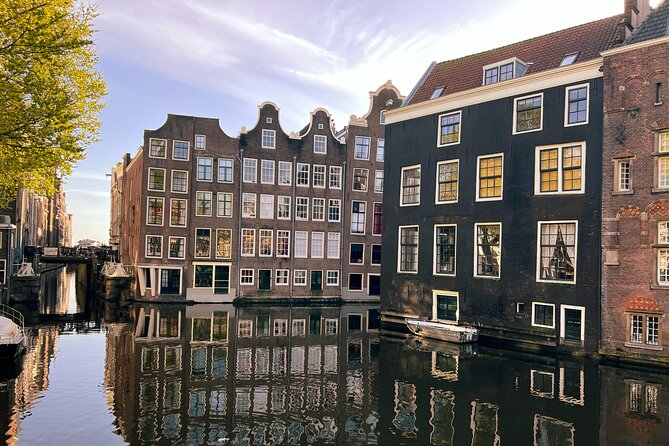
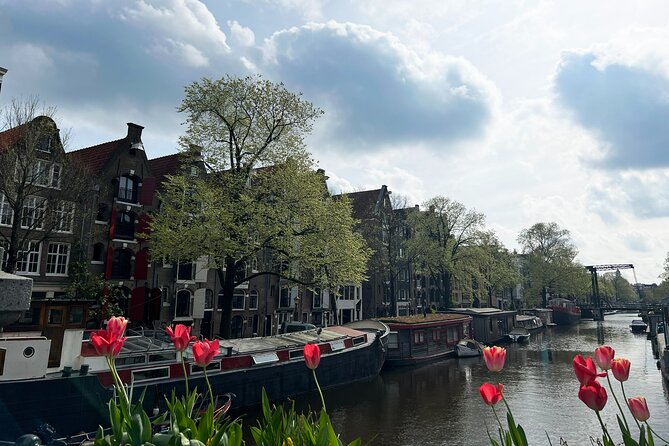
After Dam Square, you get a longer block focused on the Canal Ring, called the Grachtengordel. This is where you see the famous ring of canals built for wealthy merchants during the Golden Age.
The tour calls out northern baroque style canal houses and a variety of houseboats, so you can look for consistent design patterns. In practice, this part is the “slow down and observe” section, not just a photo stop.
This is also where biking traffic tends to show up. The route includes walking over dams and around bikes, so keep your attention on the flow of people and bicycles, especially near bridges.
Stop 8: Jordaan
Then you step into Jordaan, described as popular and charming with picturesque streets, traditional brown cafes, and unique boutiques. This is the neighborhood block that feels more like Amsterdam-as-you-experience-it, not just Amsterdam-as-you-briefly-pass-it.
You’ll have about half an hour here, which is enough time to notice street character. Look at the tight street lines, the small-scale storefronts, and the way cafes sit along pedestrian flow.
One note that can surprise people: this stop can add a human layer to the history you learned earlier. Based on the guide style reflected in the reviews you shared, Anna often personalizes the story and threads in broader cultural connections. In particular, she has a reputation for adding Amsterdam’s Jewish history context beyond the Anne Frank House area.
Stop 9: Westerkerk
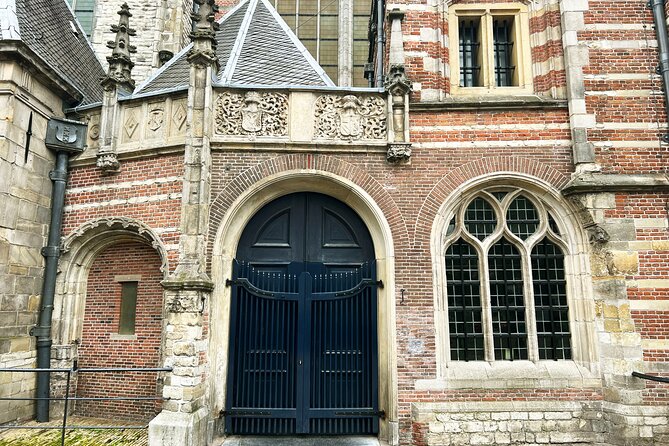
You finish at Westerkerk, a Dutch Protestant church with stylish design and an iconic spire loved by locals. Even though your time here is brief, it’s the right ending for a walking tour focused on city identity.
If you want to keep exploring right after, the location helps. You are already in an area where canals, bridges, and classic streets are within easy walking range.
The Canal Ring and Jordaan block: how to make the most of your 60 minutes
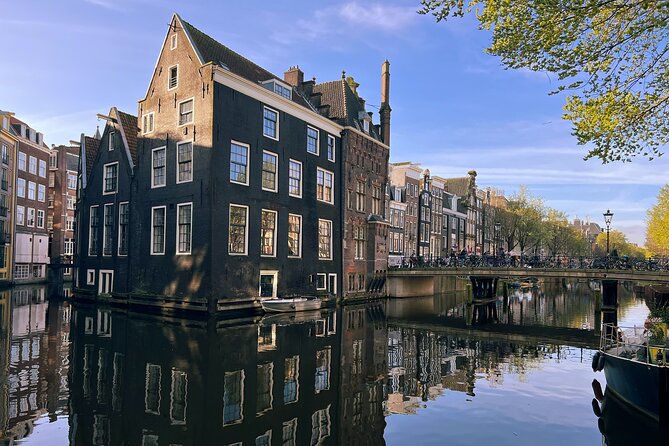
This portion is where the tour turns from facts into atmosphere. The Canal Ring is about patterns: canal layout, canal houses, and the sense of planned wealth during the Golden Age. You get about 30 minutes here, long enough to spot recurring details and compare the canal house styles.
When you’re standing near the water, think about what Amsterdam was built to do. Earlier stops framed flooding protection and defense systems, and now you can see how merchant wealth leveraged that same geography. The city becomes easier to understand when you can connect the water, the streets, and the buildings.
Then you switch to Jordaan, about another 30 minutes. This is where the city feels more lived-in, with brown cafes and small shops. If you like wandering without a strict plan, Jordaan is a perfect follow-on, especially because it is close to the end point.
Practical tip: wear shoes you can stand in comfortably. This is not museum-length seated time, it’s steady walking with frequent turning of corners. And because bikes show up near busy crossing points, you’ll want to stay aware and slow down when the crowd thickens.
Price and value: what $96.02 buys in Amsterdam
At $96.02 per person, this tour sits in the “worth it if it saves you time” category. You are paying for a private guide, and you are also getting all fees and taxes included. Each listed stop is marked as admission ticket free, so you are not stacking extra ticket costs on top.
The real value is what the guide does with that format. A private, English-language walk with a long-term resident can help you feel oriented in a short window. For many first-time visitors, that orientation prevents the “wasted wandering” problem, where you later realize you missed the logic of the city layout.
The timing is also part of the value story. The tour is listed as around two hours, but reviews you shared reference a longer, three-hour experience when questions and pacing stretched slightly. If that happens to you, you likely get more storytelling depth without extra hassle, because it’s still within the walking format.
One small practical thing: bottled water is not included. Amsterdam days can be deceptively warm, and walking builds thirst fast. I’d plan to grab water before or during the tour.
Getting there and comfort notes that actually matter
You start at Café the Schreiertower, Prins Hendrikkade 95, 1012 AE Amsterdam. You finish near Westerkerk at Prinsengracht 279, 1016 DL Amsterdam, in the area of the Anne Frank House and Westerkerk church.
It’s near public transportation, so you should not need a complicated plan just to reach the start. You’ll also get a mobile ticket, which keeps check-in simple.
Now the honest comfort considerations. This tour is not recommended if you have trouble walking and standing for about two hours. It also says mobility aids are not available, and it is not recommended for participants who use a walker. If you think you might need frequent breaks or support, you’ll likely feel stressed on this route.
The good news is that service animals are very welcome. If that applies to your group, you can book with confidence that the tour is set up for it.
Who should book this, and who might skip it
Book it if you are a first-time visitor and want your bearings quickly. The route is designed to hit Amsterdam’s layout themes in a logical order, from medieval remnants to canal wealth to a neighborhood feel in Jordaan. It’s also a strong pick if you like history that explains why buildings and streets are the way they are.
You should also consider it if you want a guide who can personalize. Anna’s style, based on the reviews, includes matching the walk to your interests, working with your group’s needs, and keeping questions flowing.
Skip it if you want long stops inside museums or if you need an itinerary that stays mostly seated. This is a walking tour, so if your legs or balance are limited, you may find it too demanding. Also, if you cannot do a continuous two-hour walk without mobility support, it’s safer to look for another format.
Should you book this historical walking tour?
Yes, if you want an efficient, local-feeling introduction to central Amsterdam. The pairing of medieval, flood protection, defense, and the Dutch East India Company story gives you a stronger mental map than the usual highlights-only walk. Add in the Canal Ring and Jordaan time, and you get both structure and atmosphere in one outing.
I would book it soon if you can, since it is typically reserved about 70 days in advance. And if you travel with a service animal, you’ll appreciate that this experience explicitly welcomes them.
If your group includes someone who struggles with walking and standing for two hours, or if you need mobility aids or walker support, I’d treat this as a no-go. In that case, you’ll get more value from a different tour type that matches your pace.
FAQ
How long is the private historical walking tour?
The tour is listed as about 2 hours.
Is the tour private or shared?
It is a private tour. Only your group participates.
What language is the tour offered in?
The tour is offered in English.
Where do we meet and where does it end?
You meet at Café the Schreiertower, Prins Hendrikkade 95, 1012 AE Amsterdam. The tour ends in the vicinity of Westerkerk at Prinsengracht 279, 1016 DL Amsterdam.
Are admission tickets included for the stops?
All fees and taxes are included, and each listed stop is marked as admission ticket free.
Is bottled water included?
No. Bottled water is not included.
Is the tour suitable for people who use a walker?
It is not recommended for participants who use a walker, and mobility aids are not available.
Are service animals allowed?
Yes, service animals are allowed.
What is the cancellation window?
Free cancellation is available up to 24 hours in advance for a full refund. If you cancel less than 24 hours before the start time, the amount paid is not refunded.
More Historical Tours in Amsterdam
- Amsterdam High-End Dutch Food & History Tour – Up to 8 guests
★ 5.0 · 482 reviews - From Amsterdam: Volendam Heritage & Cheese Half-Day Tour
★ 4.4 · 461 reviews - Amsterdam: Historic City Sightseeing Canal Cruise
★ 4.5 · 444 reviews - Amsterdam: Historical Highlights Walking Tour with Tasting
★ 4.6 · 381 reviews
Newest bookings around Amsterdam
- Amsterdam Breakfast Cruise on Private Luxury Boat★ 5.0 · 5 reviews
- Amsterdam-West Food Tour with local guide★ 5.0 · 16 reviews
- Amsterdam: Explore the Van Gogh Museum & His Masterpieces★ 3.5 · 64 reviews
- Van Gogh Museum Tour excluding Entrance Tickets★ 5.0 · 16 reviews
- Van Gogh Museum with Audio Guide★ 3.5 · 80 reviews
- Van Gogh Museum Ticket with Audio Guide and Unlimited Access Time★ 5.0 · 25 reviews
- Van Gogh Museum Entry Ticket and Guided Tour★ 4.5 · 48 reviews
- Amsterdam Van Gogh Museum with Audio or Guided Tour★ 4.0 · 266 reviews
Walking Tours, compared.

Amsterdam Anne Frank: Small-Group Walking Tour & Local Guide
Read our review →
Anne Frank’s Story – Guided Walking Tour through Amsterdam
Read our review →
Absolutely Amsterdam – the Essential Introductory Walking Tour
Read our review →
Anne Frank Guided Walking Tour in DE/EN/IT/ES
Read our review →

Anne Frank Walking Tour Amsterdam Including Jewish Cultural Quarter
Read our review →Browse the lists this tour appears in